

On Friday night at 7pm, when No. 16 Washington hosts Stanford at Alaska Airlines Arena, the Huskies enter with the better record, the more experienced roster, and one of the most dangerous offensive combinations in the country. Stanford remains talented enough to challenge anybody on the right night, but this game is less about Stanford’s history and more about Washington’s opportunity.
For decades, Stanford represented the standard Washington was trying to reach. The Cardinal won conference championships, made Final Fours, and routinely entered matchups with Washington as the favorite. More often than not, the Huskies spent those years measuring themselves against one of the sport’s premier programs.
Friday night presents a different challenge.
The expectation has changed.
Washington is no longer trying to prove it belongs on the same floor as Stanford; instead, Washington enters Friday expecting to control the game.
Through four contests, the Huskies have looked every bit like a Top 20 team. They are averaging 80.3 points per game, holding opponents to 37.8% shooting, 32.9 percent from three-point range, and forcing teams to play at an uncomfortable pace. More importantly, Washington has developed a clear identity.
The Huskies want to pressure the ball.
They want to create turnovers.
They want to turn defensive disruption into offensive momentum.
And once opponents start scrambling, they want to bury them behind elite shooting and efficient shot creation.
Stanford arrives in Seattle with enough talent to test that formula. The Cardinal also bring weaknesses that align directly with what Washington does best.
That matchup dynamic has the potential to decide the game.
Pick Your Poison: Sellers, Howell, and Trygger Are Stressing Defenses
The biggest difference between this Washington team and some of Tina Langley’s previous groups is the number of answers available when defenses try to take something away.
Everything still starts with the senior 5’7″ point guard Sayvia Sellers.
Sellers remains the centerpiece of Washington’s offense because she controls pace, creates advantages off the dribble, and consistently forces defenses into rotation. Sellers is averaging 16.8 points and 7.3 assists per game, but those numbers only tell part of the story.
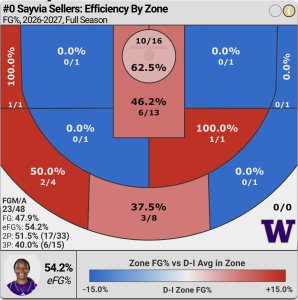
Every possession begins with the pressure she places on opponents to contain her.
The challenge for defenses is that stopping Sellers is no longer enough.
Junior 6’0″ guard Avery Howell has raised Washington’s offensive ceiling.
Howell is averaging 20.0 points per game while shooting 59.6% from the field and an incredible 60.0 percent from three-point range; as well as grabbing 6.8 rebounds. The percentages are eye-popping. More importantly, they reflect how consistently Howell has punished defensive mistakes.
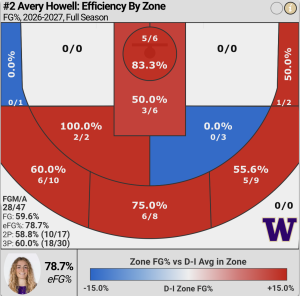
Help too aggressively on Sellers and Howell has the shooting ability to punish the rotation. Stay attached to Howell and Sellers gains driving lanes. Send help from another direction and Washington often finds an open shooter somewhere else on the floor.
Then there is Tilda Trygger.
Trygger’s ability to stretch opposing frontcourts creates matchup problems that do not always show up in the box score. Averaging 9.8 points, 8.8 rebounds, and shooting 54.5 percent from beyond the arc, Trygger forces opposing post players to defend the entire floor.
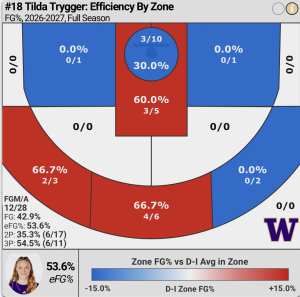
That creates difficult decisions for Stanford.
If Cardinal defenders stay home on Trygger, Washington creates driving angles for Sellers and Howell. If they collapse toward the lane, Trygger becomes a dangerous release valve on the perimeter.
Washington’s offense works because opponents rarely have a correct answer.
Every adjustment opens another opportunity somewhere else.
Stanford’s Hailee Swain, A Star Washington Must Contain
Washington’s scouting report begins with Hailee Swain.
The sophomore guard has emerged as Stanford’s offensive centerpiece, averaging 22.2 points per game while shooting 53.2 percent from the field and 45.0 percent from three-point range.
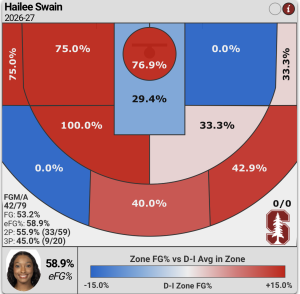
She has scored at least 20 points in every game this season and enters Friday playing some of the best basketball of her career.
Swain’s scoring ability presents the obvious challenge.
Her versatility presents the bigger one.
She can attack downhill, score from the perimeter, and generate offense late in possessions when defensive pressure takes away a team’s primary action.
Washington does not necessarily need to shut Swain down; instead, the Huskies need to make her work for everything.
The challenge becomes more complicated because Stanford has enough complementary talent to punish an overly aggressive defensive approach.
Junior guard Shay Ijiwoye averages 11.4 points and 4.4 assists per game while acting as a secondary playmaker. In the frontcourt, Nora Ezike and 6’5″ Alexandra Eschmeyer give Stanford two efficient interior scoring options capable of finishing around the basket and extending possessions on the offensive glass.
The danger for Washington is allowing Swain to establish rhythm early and create easier opportunities for everyone around her.
Washington’s goal is simple: make Stanford’s role players beat them. If Swain is carrying the offense in the fourth quarter, the Huskies want every point to come the hard way.
Stanford Has One Huge Problem Washington Is Built to Exploit
Washington’s biggest advantage may not involve shooting.
It might involve possession count.
Stanford averages 19.2 turnovers per game and owns a 0.69 assist-to-turnover ratio. For a roster built around underclassmen, those numbers reflect the inconsistency that often comes with youth.
Unfortunately for the Cardinal, they are facing a team specifically designed to exploit that weakness.
Washington averages 10.0 steals per game and consistently pressures opponents at the point of attack. The Huskies are aggressive in passing lanes, active on ball screens, and quick to turn defensive stops into offensive opportunities.
More importantly, Washington understands how to capitalize once those turnovers occur.
Washington uses turnovers as offensive fuel.
Three consecutive mistakes can lead to three Washington baskets and change the complexion of a game in less than two minutes.
That dynamic represents one of Stanford’s biggest concerns entering Seattle.
The Cardinal have enough offensive skill to compete in the half court.
The question is whether they can protect the ball well enough to actually get there.
Washington’s Three-Point Advantage Could Decide the Game
Few statistical differences between these teams stand out more clearly than where their points originate.
Washington wants to stretch defenses across the entire floor.
Stanford prefers to win inside the arc.
The Huskies generate 43 percent of their scoring from three-point range while shooting nearly 42 percent as a team from deep. Stanford, meanwhile, derives more than 60 percent of its offense from two-point baskets and shoots just 29.8 percent from beyond the arc.
That contrast creates one of the game’s most intriguing tactical battles.
Stanford would prefer a physical game played around the lane where its size and interior efficiency become factors.
Washington would prefer a game with pace, spacing, and plenty of possessions where its perimeter talent can take over.
The Cardinal’s defensive numbers provide another reason for optimism on the Washington side.
Opponents are shooting 38.1% from three against Stanford through five games. If Sellers, Howell, Trygger, and Washington’s supporting cast continue generating the quality looks they have all season, the Huskies possess a clear scoring advantage from the perimeter.
That advantage becomes difficult to overcome because of simple arithmetic.
Two-point baskets can keep Stanford competitive.
A barrage of made threes can create separation in a hurry.
Stanford’s Frontcourt Will Battle-Test Washington’s Bigs
For all of Washington’s advantages on the perimeter, the Huskies cannot afford to lose the battle around the basket.
Stanford’s frontcourt provides a legitimate challenge.
Ezike and Eschmeyer both finish efficiently around the rim and have helped Stanford establish a productive interior attack. Eschmeyer also protects the rim effectively, giving the Cardinal another way to impact the game defensively.
Washington’s frontcourt has played well to open the season, but Friday presents a different kind of test.
Can 6’3″ Brynn McGaughy (4.5 defensive rebounds, 6.5 total rebounds per game) and the Huskies control the defensive glass?
Can McGaughy and Trygger defend physically without creating foul trouble?
If Stanford consistently earns second-chance opportunities, the Cardinal gain a pathway to staying close regardless of what happens beyond the arc.
Washington does not need to dominate the paint.
The Huskies simply need to avoid giving away an area where Stanford may hold its best advantage.
Three Keys to a Washington Victory
1. Force Stanford Turnovers, Fuel Washington’s Transition Attack
Stanford averages 19.2 turnovers per game, a vulnerability that plays directly into Washington’s defensive identity. The Huskies need to turn those extra possessions into transition baskets and early-offense opportunities, where Sellers, Howell, and Washington’s shooters are at their most dangerous.
2. Make Someone Other Than Hailee Swain Beat You
Swain has emerged as Stanford’s offensive engine, averaging 22.2 points per game while shooting efficiently from all three levels. Washington’s defensive priority should be limiting her impact and forcing the Cardinal’s secondary scorers to create offense under pressure.
3. Exploit Washington’s Explosive Three-Point Advantage
The Huskies enter the matchup shooting 41.8 percent from beyond the arc, while opponents are shooting 38.1 percent from three against Stanford. If Washington generates the same quality looks it has throughout the season, Stanford’s interior-oriented offense may struggle to keep pace on the scoreboard.
If Washington checks those three boxes, the matchup begins to tilt heavily in the Huskies’ favor. Stanford has enough talent to make Washington work, but the Cardinal’s biggest weaknesses align directly with Washington’s biggest strengths.
Washington Has a Chance to Make a Statement
Stanford remains one of the most recognizable brands in women’s basketball. Any victory over the Cardinal carries significance.
But Friday’s opportunity extends beyond the name on the opposite bench.
Washington enters the game looking like one of the most complete teams in the country. The Huskies have elite shot-making, veteran leadership, frontcourt versatility, and a defensive identity capable of disrupting quality opponents.
Now comes the next step.
Good teams beat opponents.
Very good teams identify favorable matchups and exploit them.
Washington enters Friday with advantages in perimeter shooting, ball security, experience, and defensive pressure. The Huskies do not need a perfect performance to win. They need a disciplined one.
The formula is straightforward.
Protect the basketball.
Force Stanford into mistakes.
Continue generating quality looks from three.
Stanford has enough talent to make Washington work for forty minutes.
The Huskies have more than enough answers to control the game.
Friday night is an opportunity for Washington to show just how much the balance of this matchup has changed.
And if the Huskies play to their identity, it may be another step toward proving they belong in the conversation with the nation’s best teams.
GO DAWGS!
*Win Probability: 84%
*Score Prediction: Washington 83, Stanford 68
* The author, UDUBWBB.com and UDUB Husky Hype do not endorse sports gambling or wagering in any form; the stated win probability and score prediction for this contest are strictly for entertainment purposes only.


