

On Sunday, February 1st, the Washington Huskies (17–4 overall, 7–3 Big Ten) welcome the Illinois Fighting Illini (15–6 overall, 5–5 Big Ten) to historic Hec Ed for an intriguing contrast of styles.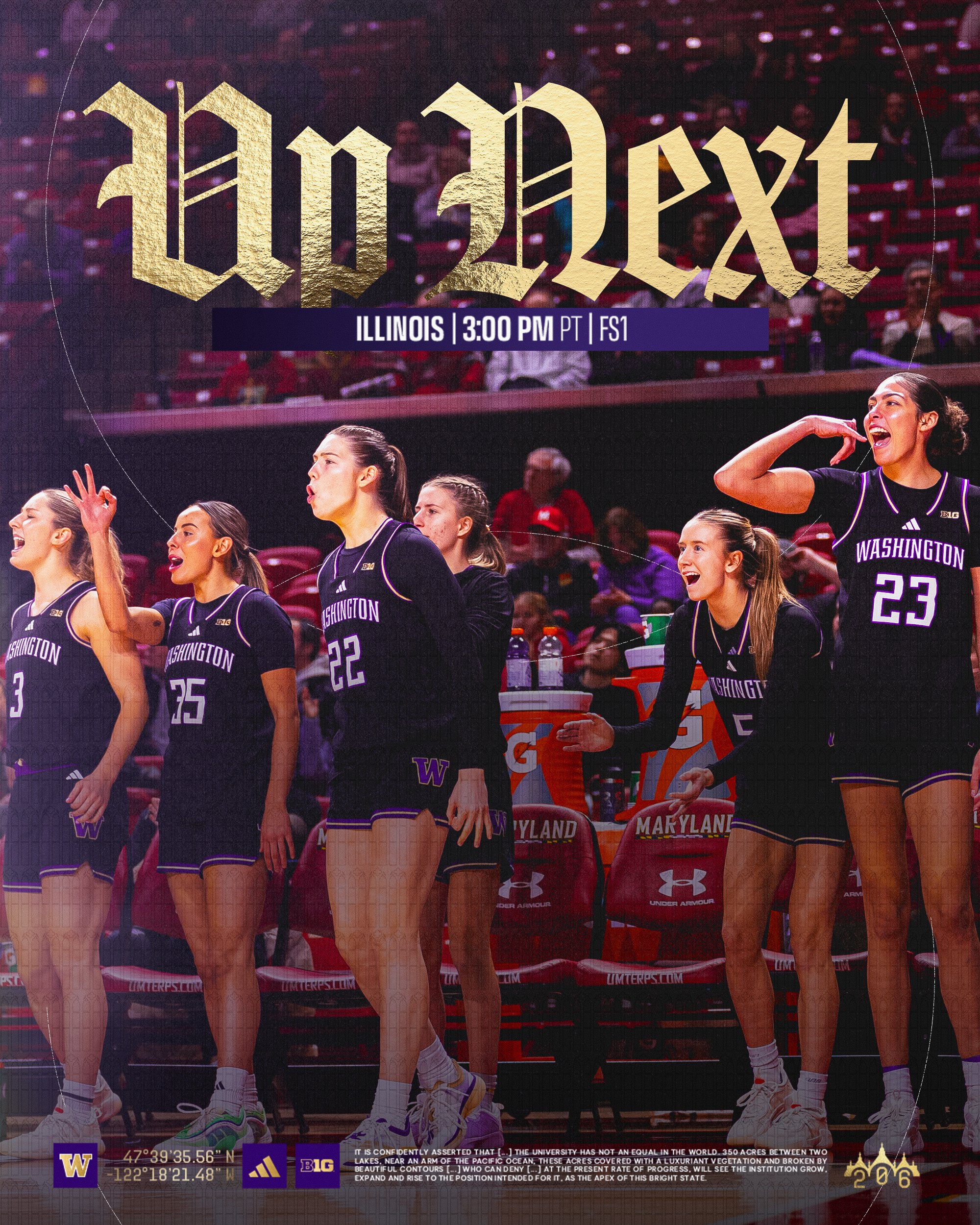 On one side stands Washington, a team that has carved out a 17–4 record with suffocating defense, elite efficiency, and relentless rebounding.
On the other side is Illinois, a 15–6 squad that thrives on tempo, scoring volume, and a modern, “run and gun” offense.
The Huskies proved they can grind out wins in hostile environments, as evidenced by their recent 83–80 double‑overtime victory at Maryland.
Now, the Huskies return to Seattle and the familiar confines of Hec Ed where they have yet to taste defeat this season.
The Dawgs have chance to further validate their defensive dominance against one of the most potent offensive attacks in the country.
Washington Preview
Washington’s identity begins on the defensive end.
The Dawgs allow only 58.6 points per game, which ranks the Huskies among the best major‑conference defenses in the nation.
The Huskies hold opponents to just 38.2% shooting from the field, which reflects not the intense pressure o UW’s perimeter defenders, but also a strong interior presence that forces tough, contested looks.
Moreover, the Huskies do not just defend the first shot; their control of the defensive glass is central to the Huskies’ defensive blueprint.
Washington pulls down 41.6 rebounds per game, significantly outpacing the Illini’s 36.7 boards.
This rebounding edge should allow UW to control tempo, limit Illinois to one‑and‑done possessions by denying the Illini second chance opportunities via offensive rebounds.
Offensively, Washington currently averages 74.3 points per game; while the Huskies defense hold opponents to 58.6 points per game on 38.2% shooting from the field.
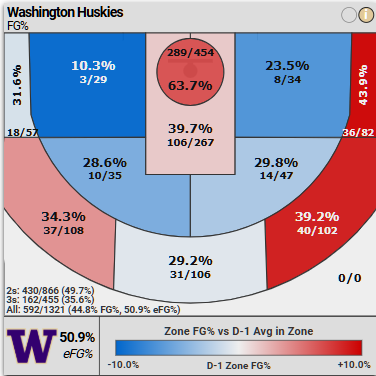
The Huskies offense is highly efficient scoring at the rim (within 4.5 feet) making 63.7% of their shots; however, Washington is only shooting 39.7% from farther away in the lane.
Meanwhile, the Dawgs are punishing defenses with red hot 35.6% accuracy from three-point range.
 Sayvia Sellers embodies the Dawgs’ offensive edge by averaging 19.2 points, 3.6 assists, and 1.6 steals per game.
Sellers’ efficiency keeps the Husky offense humming: she converts 58.2% of her two‑point attempts, knocks down 38% from beyond the arc, and finishes an elite 72.5% at the rim.
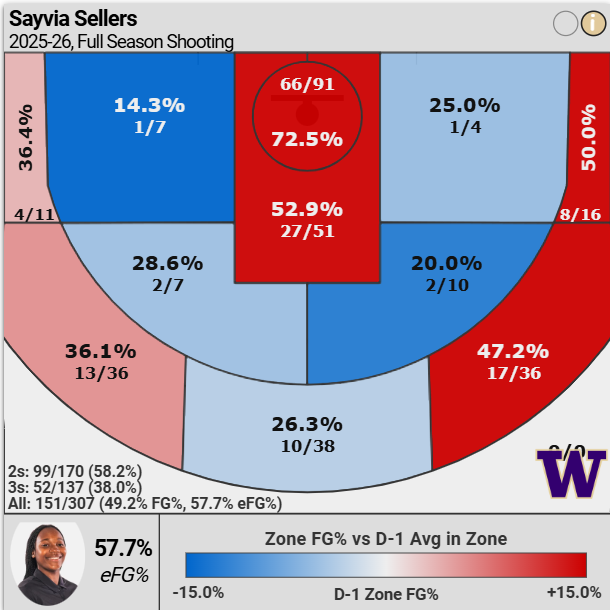
Sellers is much more than a one-dimensional scorer — she stretches defenses to their breaking point.
Sellers can dictate the Husky offense on her own terms late in the shot clock and late in games.
Sellers’ ability to create off the dribble and navigate ball screens is a safety valve that most teams lack.
In close contests—like the Maryland double overtime thriller—Washington can trust Sellers to get a quality shot or make the right read.
Against an Illinois team that wants to speed things up, Sellers’ poise will be crucial in controlling the game’s pace to Washington’s liking, exploiting mismatches, and turning crucial possessions into points, not turnovers.
Washington has developed a strong core to support Sellers’ dynamic offensive game.
Avery Howell has emerged as a quintessential modern wing for Washington.
Howell averages 13.1 points per game; grabs 8.1 rebounds; plus 1.5 steals — while stretching defenses with a blistering 41.5% accuracy from three-point range.
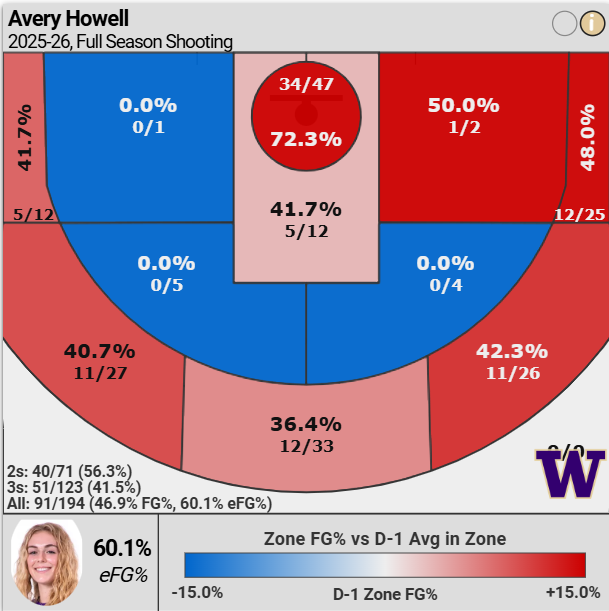
Avery Howell’s ability to both space the floor and crash the glass makes her a nightmare matchup for the Illini, who will have to decide whether to chase her off the line with a smaller defender or protect the paint with a bigger player.
Meanwhile, Elle Ladine adds another versatile scoring threat at 10.3 points; 61.5% scoring at the rim; 39.3% accuracy from three; and 4.8 rebounds per game.
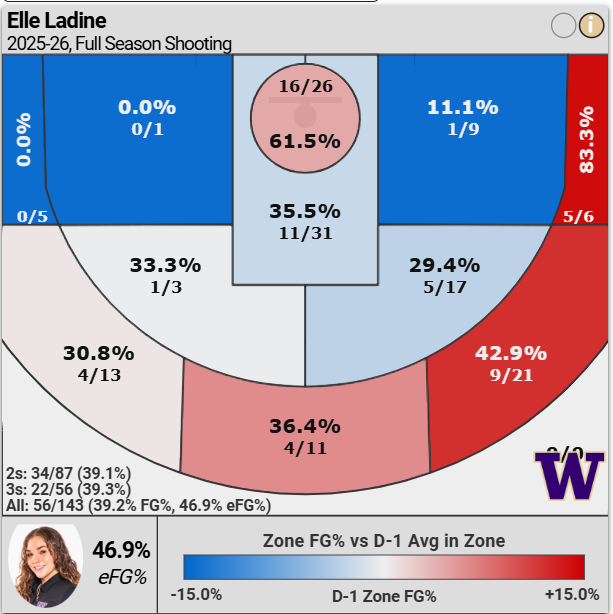
Ladine can bomb from three-point range; attack closeouts; finish through contact; and help push the ball in transition when opportunities arise.
Finally, freshman forward Brynn McGaughy provides rim protection at 1.2 blocks per game; grabs 5 rebounds; and scores 8.5 points, and scores 8.5 points on shooting.
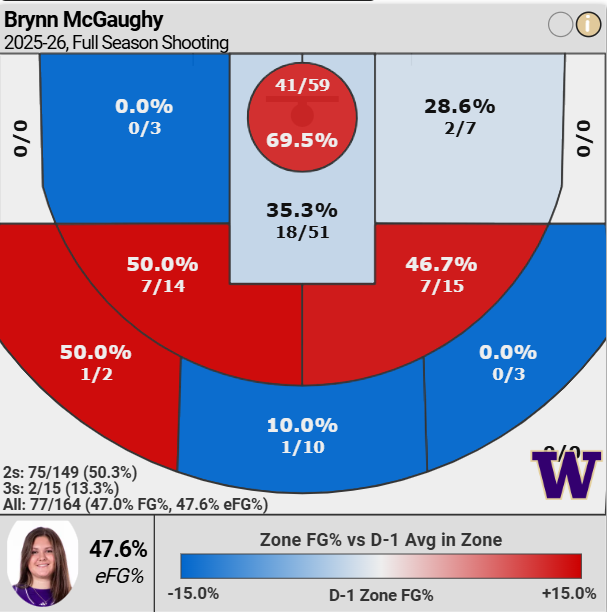
Together, this key core allows Washington to maintain its defensive integrity without sacrificing offensive balance, which is especially important against a team as explosive as Illinois.
The Illini will arrive in Seattle with a high-octane offense looking to counter-punch the Huskies defense.
Illinois averages 78.4 points per game, outpacing Washington’s 74.3 and signaling clear offensive firepower.
They shoot 45.4% from the field overall, including 49.4% on two‑pointers and 34.9% from deep.
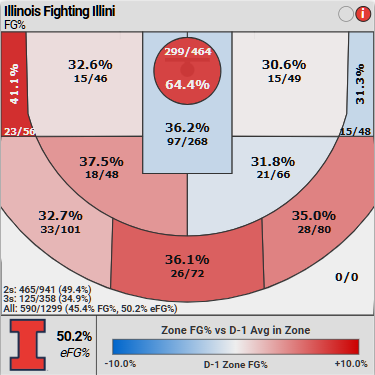
Even though they have dropped two straight—80–67 to UCLA and 81–75 at Nebraska—their underlying offensive profile remains dangerous. When the Illini get into a rhythm, they can turn games into track meets.
At the center of the Illini attack is dynamic scorer Berry Wallace.
Wallace, a 6’1″ sophomore forward, at 19.3 points per game mirrors Sellers’ production but brings her own brand of shot‑making, converting 56.7% on two‑pointers and 36.1% from three-point range.
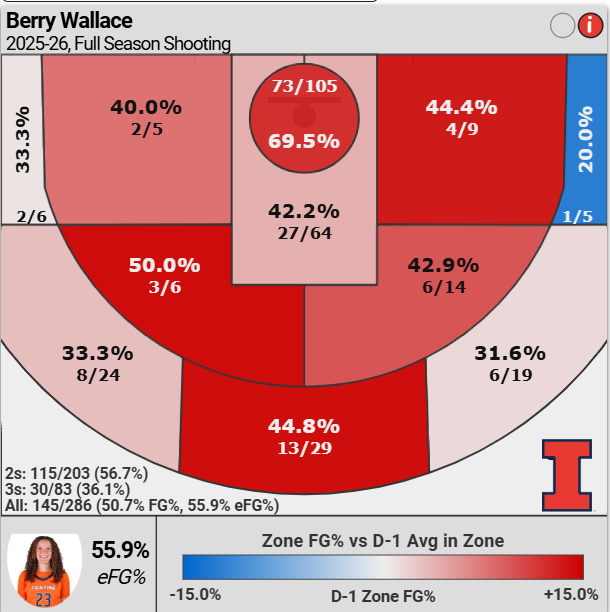
 Wallace uses her aggressive drives to attack closeouts, punish gaps in the defense, and force officials to blow their whistle.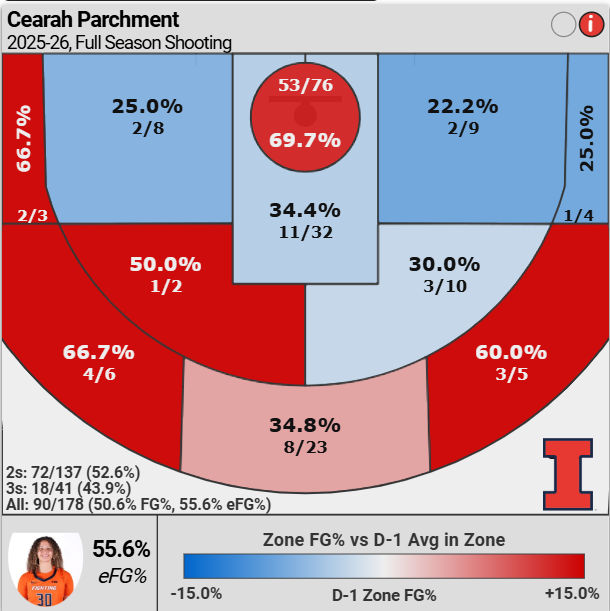
 Additionally,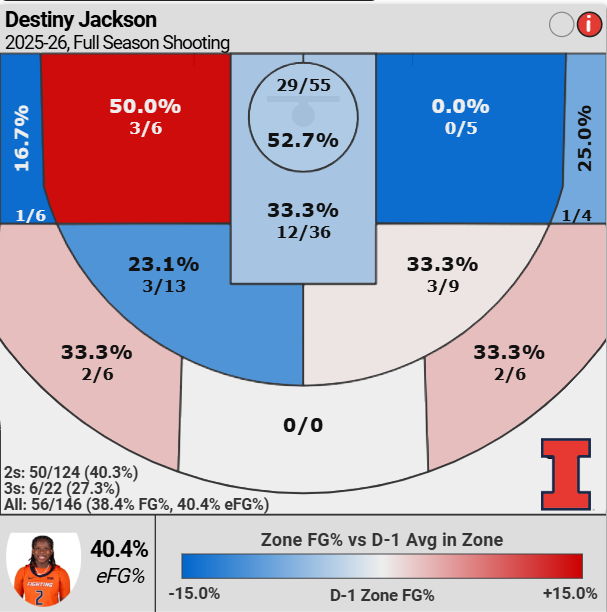
 Jackson’s ability to push tempo after turnovers or missed shots is central to Illinois’ philosophy. If the Illini can get UW into early‑offense situations and force the Huskies to defend in transition rather than set their half‑court defense, they can change the game into a track meet which favors them.

