Shock Hosting Shock Hosting
  • HomeCourt
No Result
View All Result
  • HomeCourt
No Result
View All Result
UDUBWBB.com
No Result
View All Result
Home #UDUBWBB

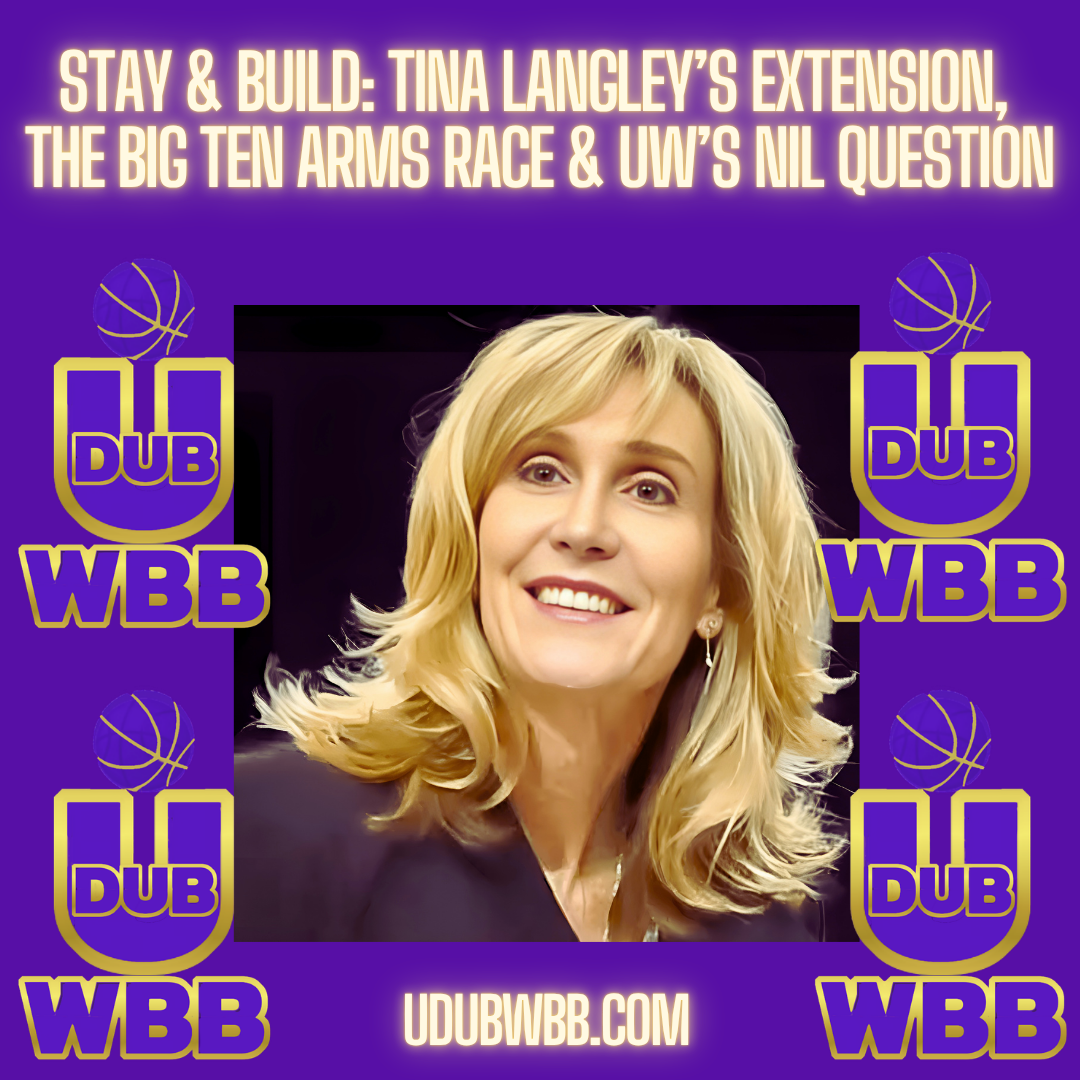
Stay & Build: Tina Langley’s Extension, the Big Ten Arms Race, and UW’S NIL Question

by Nesto Roland
April 5, 2026
in #UDUBWBB
Reading Time: 7 mins read
Stay & Build: Tina Langley’s Extension, the Big Ten Arms Race, and UW’S NIL Question

Prelude to a Commitment
News of Alabama’s coaching hire broke early Wednesday, when the Alabama Crimson Tide officially announced their selection of Pauline Love, former Oklahoma Associate Head Coach, as their next head women’s basketball coach;— a development that effectively closed the door on any lingering speculation about Washington Women’s basketball Head Coach Tina Langley’s possible Alabama homecoming.

On Thursday, UW’s official announcement of a contract extension for Langley was released; and details of a 6-year extension worth $7.1 Million through the 2032 season quickly circulated — an increased salary that places real weight behind the school’s public vote of confidence.

The Montlake Message: Washington Chose Continuity
Timing, in modern college athletics, is half the battle. For Washington, the extension didn’t merely end speculation; it eliminated uncertainty at the exact moment uncertainty is most expensive—right before the portal-driven roster churn that can reshape a roster in days. Consequently, UW’s message to recruits, current players, and donors was simple: the coach is staying, and the plan remains intact.

Equally important, the decision reflects how women’s basketball now works at the highest level. Coaching stability isn’t a bonus feature anymore. Instead, it functions like a competitive asset that protects roster retention, recruiting credibility, and the program’s identity. By locking in Tina Langley, the Washington Huskies aren’t just keeping a leader—they’re stabilizing an ecosystem.

Stability, Leverage, and New Economics of Washington Women’s Basketball
Langley’s decision to stay reads less like sentiment and more like modern strategy. Coaches now evaluate more than just their salary; they weigh staffing, recruiting infrastructure, transfer-portal readiness, travel demands, facilities, and—more than ever—the school’s NIL commitment.

At the same time, UW’s new Big Ten reality sharpens every investment concern. The conference is deeper, more resourced, and less forgiving of “almost” programs. If Washington wants women’s basketball to become a flagship brand in this new footprint, the program must be treated like a long-term build—not a seasonal storyline that peaks when the standings cooperate.

Coach Continuity: A Value-added Strategy in a Volatile Market
Washington’s decision to retain Langley functions as a hedge against the most expensive outcome in college sports: instability. Across the country, coaching changes routinely trigger roster instability, and roster instability triggers multi-year program resets. As a result, continuity has become a competitive advantage—especially for programs that win through development, cohesion, and culture rather than quick-fix roster flips.

Tina Langley’s system thrives on multi-year growth and a defensive scheme that strengthens with experience — that means player retention is not just preferable; for the Huskies, it’s fundamental. So, UW’s contract extension is not only a reward for what Langley accomplished yesterday—it is (hopefully) securing a future harvest of success, provided the foundation stays intact.

UW’s Resource Politics: A Subtle but Real Recalibration
Washington’s extension also neutralized a familiar threat: a resource-heavy program attempting to pry away a coach at the moment leverage is highest. Put plainly, UW didn’t just “keep its coach.” It chose to compete in a marketplace where retention is often determined by whether an athletic department elevates a program’s internal priority quickly enough to matter.

Historically, Washington women’s basketball hasn’t always sat at the very top tier of department-wide investment. However, Big Ten membership forces a recalibration whether anyone asks for it or not. If UW wants the Washington Huskies brand to carry nationally across broadcasts, digital platforms, and recruiting cycles, women’s basketball can drive that visibility—if the department backs it with resources that match the conference’s expectations.

Washington AD Pat Chun signaled that UW is prepared to elevate women’s basketball into its core portfolio of funded programs. Beyond Langley’s increased salary, this should include the following factors, without exception:

  • increased staffing and recruiting support

  • enhanced operational budgets

  • alignment with Big Ten‑level expectations for facilities and travel

  • increased structured partnership with NIL collectives

These significant commitments to Langley’s program will reflect a broader institutional understanding: in the Big Ten, underinvestment in high profile sports is not a neutral choice — it is conceding defeat, or worse, irrelevance.

Beyond Increased Salary: What “Support” Must Actually Mean
The salary bump is the headline, yet money alone doesn’t operate a modern program. To translate stability into sustained wins, UW must build the machine around Tina Langley: more staffing, stronger recruiting infrastructure, enhanced budgets, and Big Ten-caliber travel and logistics. Otherwise, the extension risks becoming a symbolic victory instead of a competitive edge.

Just as crucially, Washington must build structured alignment with NIL partners. Many schools now operate with an organized pipeline connecting coaches, collectives, donor networks, and brand opportunities. Therefore, if UW truly wants to “double down,” NIL coordination has to become standard program infrastructure—not an optional add-on that lags behind peer competition.

UW Roster Dynamics and the Cost of Disruption
The Alabama conversation created real vulnerability because the calendar is ruthless. The transfer portal opens immediately after the national title game, and programs across the country move fast to secure experienced players. For Washington, that urgency is amplified by roster change after losing four seniors and one graduate player, which makes stability even more valuable in the short term.

Meanwhile, UW has underclassmen who chose Tina Langley’s developmental model because it promised growth, role clarity, and culture. If she had left, the program could have faced immediate attrition—followed by the hidden costs of a reset: re-recruiting your own locker room, scrambling for replacements, and losing continuity that takes years to rebuild. Consequently, the extension wasn’t just emotional insurance; it was practical risk management.

Indeed, talented rising sophomore guard Sienna Harvey’s representative confirmed her intention to enter the transfer portal and increased the sense of urgency surrounding UW WBB’s off-season moves to shore up the roster — particularly, the backcourt.

NIL as a Decisive Factor in Program Trajectory –and the Missing Piece in the Headlines
NIL is now a decisive variable in coaching decisions, roster retention, and portal recruiting. That reality makes one detail worth a clear-eyed look: the public-facing terms of this extension emphasize length and compensation, yet they do not obviously include an explicit, measurable NIL commitment tied to program goals. Even if such support exists behind the scenes, the lack of clarity creates a perception gap—and perception affects recruiting.

This matters because the Big Ten does not forgive resource ambiguity. Washington doesn’t need to imitate every national superpower dollar-for-dollar, but it does need a credible NIL pathway for recruits and returners. Going forward, UW should reduce uncertainty by building a stable framework that players and families can trust—one that is organized, visible, and upward-trending. In short, a bigger salary retains the coach; a real NIL plan retains and upgrades the roster that makes the coach’s system work.

UW’s Big Ten Positioning: A Window the Dawgs Can’t Afford to Miss
The Big Ten’s expansion created a temporary period of competitive fluidity. Early movers—programs that stabilize leadership, identity, and roster strategy—can climb before the hierarchy hardens again. Therefore, keeping Tina Langley matters not only because she’s effective, but because she gives UW the chance to move early while other programs still adjust to new travel demands, recruiting maps, and conference expectations.

However, retention alone is only three-fourths of the formula. UW can have a defined identity, a stable core, and a coach aligned with institutional priorities—and still fall short if NIL stagnates. If Washington pairs this extension with a stronger, clearly organized NIL ecosystem, then the Big Ten transition can become a launchpad rather than a grind of “almost there” seasons.

A Decision Shaped by a Shifting National Coaching Market
Langley’s extension also reflects a national trend: the coaching market is more aggressive and less predictable than it was five years ago. Power-conference athletic directors now target culture builders and system architects earlier, because waiting carries risk. In women’s basketball, the surge in investment has accelerated mobility—and the supply of proven program builders rarely meets demand.

Long-Term Positioning: The Extension Should Trigger the Next Phase
From a program-building perspective, this move is more than retention. It’s a statement that UW values the long arc—culture, development, and a recognizable identity. Replacing a true program-builder is harder than replacing a playbook, and Washington acted accordingly by keeping Tina Langley in Montlake for the long haul.

Langley also earned leverage with results. Washington’s 2026 NCAA tournament showing—highlighted by a runaway first-round win over South Dakota State and a battle that pushed TCU to its limits—offered a national glimpse of what this can look like when the pieces align. Yet if UW wants that level to become routine, the extension must represent more than security for the head coach. It must also unlock deeper commitment to the ecosystem around her—especially a visible, credible NIL plan that matches the competitive realities of the Big Ten.

The Bottom Line in Montlake: The Extension Is Step One, Not the Finish Line
The Washington Huskies kept their coach, protected their culture, and avoided a destabilizing reset. In a volatile market, preserving trajectory is often the smartest move—especially when the foundation is young and needs time, repetition, and belief to mature into consistent winning.

Now comes the harder work: turning continuity into separation. The Dawgs have momentum, and Tina Langley has the blueprint. Next, UW must fund the blueprint like a Big Ten program—staffing, operations, recruiting, and especially NIL—so that the extension becomes the start of a climb, not the end of a headline.

GO DAWGS!

facebookShare on Facebook
TwitterTweet
FollowFollow us
Tags: FeaturedFeatured - Editor's Picksticky

Follow UDUBWBB1

    The Instagram Access Token is expired, Go to the Customizer > JNews : Social, Like & View > Instagram Feed Setting, to refresh it.
Twitter Instagram
Currently Playing

@UDUBWBB is UW WBB

    The Instagram Access Token is expired, Go to the Customizer > JNews : Social, Like & View > Instagram Feed Setting, to refresh it.

Welcome Back!

Login to your account below

Forgotten Password?

Retrieve your password

Please enter your username or email address to reset your password.

Log In

Add New Playlist

No Result
View All Result
  • #ProDawgsVideo
  • About
  • HomeCourt
  • Podcasts
  • Privacy Policy
  • UW_WBB

© 2020UDUBHoops.com - Website Design & LogosCreativeGeniusTech.