

On Friday, March 20, 2026, UW faces a first-round opponent that rarely beats itself—South Dakota State.

Washington enters the NCAA March Madness Tournament (21–10 overall; 10-8 Big Ten) with a clear identity: the Huskies play fast enough to create pressure, tough enough to defend and rebound against some of the nation’s top teams, and skilled enough offensively on the perimeter to swing games in short bursts.
South Dakota State (27–6 overall, 14-2 Summit) arrives with an efficiency profile that jumps off the page. The Jackrabbits score 76.6 points per game while allowing only 61.2, and they pair that margin with disciplined shot selection and steady decision-making. Consequently, this game sets up as a classic tournament contrast: Washington’s two-way pace-and-pressure approach versus South Dakota State’s structured and efficient execution.
UW’s Blueprint: Balanced Scoring, Defensive Bite
The numbers show a Washington team that wins with two-way steadiness. The Dawgs average 71.7 points and only allow 62.2 points, while holding opponents to 40.4% shooting and a stingy 28.9% from three– those numbers reflect a group that contests, rotates, and rebounds with intent. And UW’s three-point defense matters immediately, because SDSU also leans on perimeter spacing and shot-making to unlock its interior scoring.
Offensively, UW shoots 44.9% overall, hits 34% from three, and converts 51% on twos, including 67% at the rim. Just as important, Washington’s balanced scoring distribution: 55.6% of points come from two-point range and 30.9% come from deep.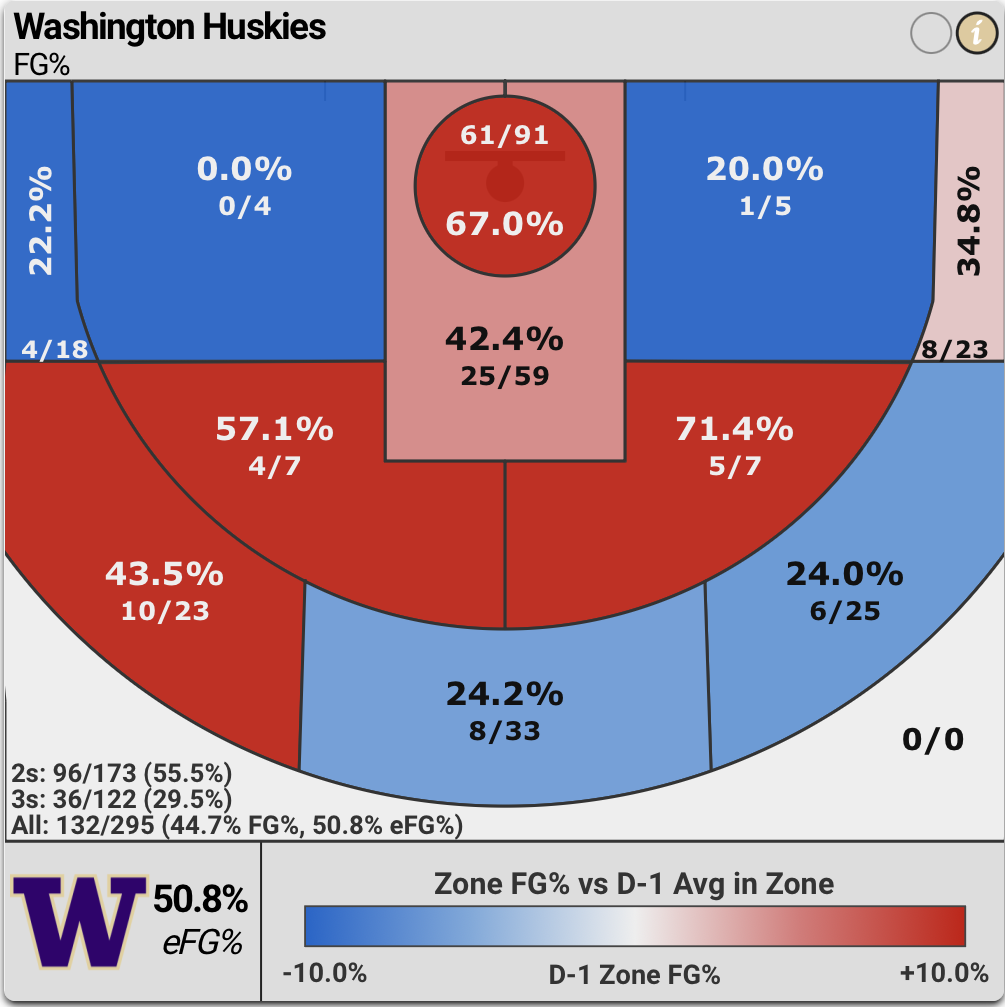 In other words, the Huskies can win with rim pressure or perimeter pressure —provided they protect the ball (15.1 turnovers per game) well enough to keep their defense from constantly scrambling.
The Tempo and Pace Tug-of-War
Pace (# of possessions in a game) vs. tempo (game flow) will often determine the team that imposes its will. Meanwhile, both teams play at nearly the same pace. Washington sits at 68.6 possessions per 40 minutes, while South Dakota State runs 69.8 offensive possessions. That similarity matters because it suggests the game won’t be decided by pace alone—it will be decided by who controls what style of pace dominates, i.e., tempo. Washington wants speed of controlled chaos; its best moments come when defense becomes ignition. Meanwhile, South Dakota State wants well-organized speed.
Assists, Turnovers and Efficiency
Offensive efficiency may be the most glaring contrast. The Jackrabbits shoot 48.4% overall, 55.4% on twos, and 35.1% from three. Washington shoots well too (44.9% overall, 51% on twos, 34% from three), but SDSU’s edge shows up in cleaner possessions: 16.0 assists per game and only 13.5 turnovers. Meanwhile, the Huskies average only 4.1 assists versus 15.1 turnovers, which means UW’s path to victory often requires forcing the opponent into more mistakes than Washington makes.
Consequently, Washington’s challenge is to make SDSU play faster than it wants, especially early in the shot clock, to create uncomfortable possessions. When UW adds steals (6.9 per game) and blocks (4.0) to its defensive mix, it can lead to runouts and rhythm threes — the ultimate test of SDSU’s transition defense.
Sayvia Sellers: The Decision-Engine Behind UW’s Offense
Washington’s 5’7″ point guard Sayvia Sellers averages 18.5 points with 3.7 assists, and she does it efficiently inside the arc (58.4% on twos), including at the rim (68.2%), while stretching defenses from three-point range (35.9%), which prevents opponents from sagging into the lane and waiting for help. As a result, the Washington Huskies gain space for cutters, room for secondary offensive actions, and cleaner angles for kick-outs.
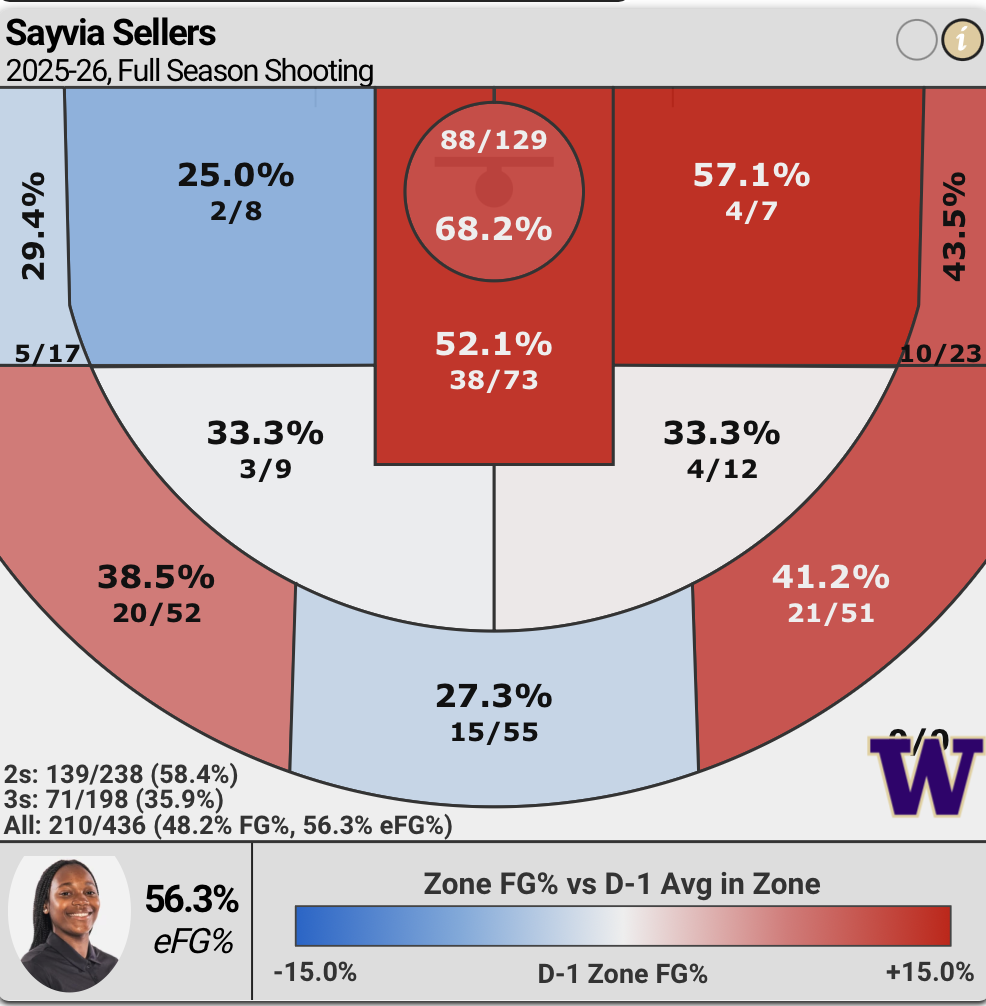 Sayvia Sellers forces defenses into choices they don’t want. When she turns the corner and gets into the paint, she will South Dakota State’s help into uncomfortable rotations; or If Sellers can attack downhill, she will stress their rim protection; however, if they load up on her drives, her kick-outs can spark quick-swing threes that fuel scoring runs—an endgame weapon for UW.
Therefore, whenever Sellers dictates the tempo of UW’s offense, the Dawgs gain a tournament-grade advantage: as the number of possessions tighten, scouting reports sharpen, and easy looks disappear; Sellers’ ability to manufacture points can still bend and stretch defensive schemes.

Avery Howell’s Two-Way Threat: Rebound, Hit from Deep, Repeat
Avery Howell gives UW a steady second star: a physical, relentless two-way wing/guard who rebounds like a forward, provides elite three-point sharpshooting and an excellent individual defense–her stat line reads like an answer to any postseason stress.
The 6’0″ sophomore produces 13.7 points and a massive 8.3 rebounds per game, and she pairs that work rate with a rare blend of touch: 64% on twos, including an elite 74.6% at the rim, and an elite 41.9% from three. Howell’s elite shooting matters because it punishes any defense that tries to load up on Sellers’ drives.
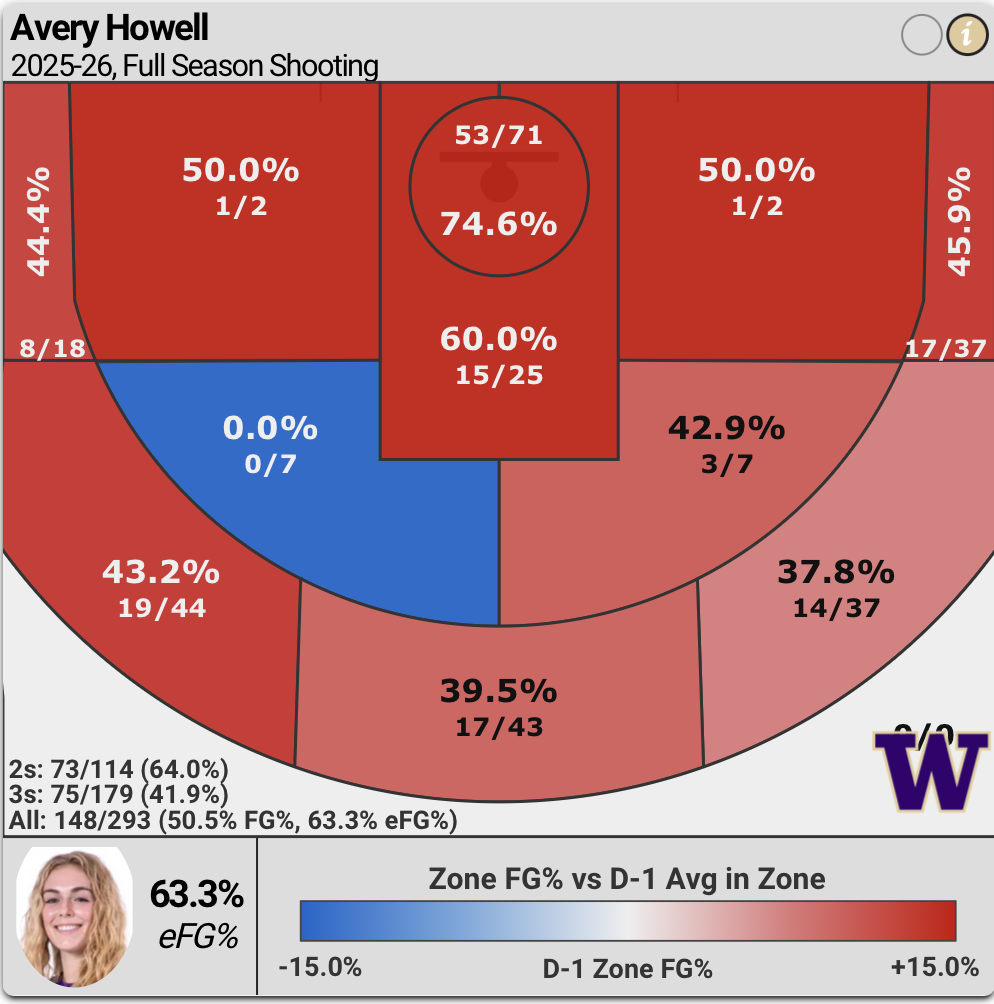

Howell also connects directly to one of Washington’s quiet statistical edges: offensive rebounding. UW grabs 12.4 offensive boards per game compared to SDSU’s 10.2, and second chances can become the equalizer against a team that otherwise wins the efficiency battle. If Howell helps the Dawgs generate extra possessions without sending the Jackrabbits to the free-throw line, Washington can keep the game in its preferred emotional range.
The Paint Problem: SDSU’s Brooklyn Meyer
South Dakota State’s offensive center of gravity is 6’2″ senior forward Brooklyn Meyer. Meyer averages 22.4 points and 8.0 rebounds with 2.7 assists, and she finishes at an elite rate (65.2% on twos, including an elite 68.2% finisher at the rim), while protecting the rim defensively(1.9 blocks).
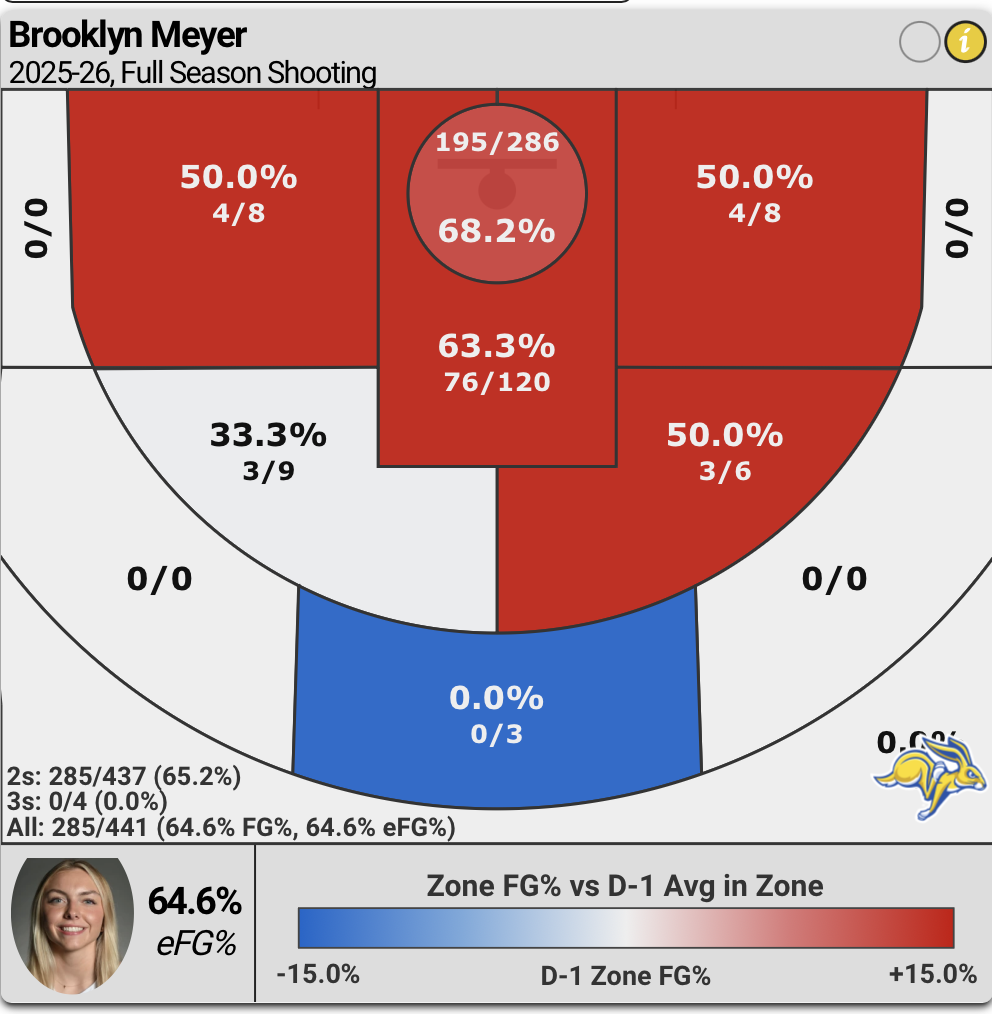
Washington will not “stop” Brooklyn Meyer’s offense with only one defensive look; instead, the Huskies must manage it. That means Brynn McGaughy’s length (1.1 blocks per game), Howell’s physicality on the boards, and timely help that arrives early—but doesn’t linger too long. If UW guards her straight up and she scores anyway, SDSU controls both the scoreboard and most likely the foul situation.
That foul situation is the red flag. Washington averages 15.8 fouls per game, while SDSU sits at 12.9 fouls. Therefore, the Huskies must defend Meyer with physicality and discipline—showing help at the right times without reaching, and rotating early enough to avoid desperation contact.
At the same time, UW must defend the consequences of helping defensively. SDSU shoots 48.4% overall, 55.4% on twos, and 35.1% from three — with snipers like Madison Mathiowetz (40.1% from three) and Emilee Fox (47.7%).
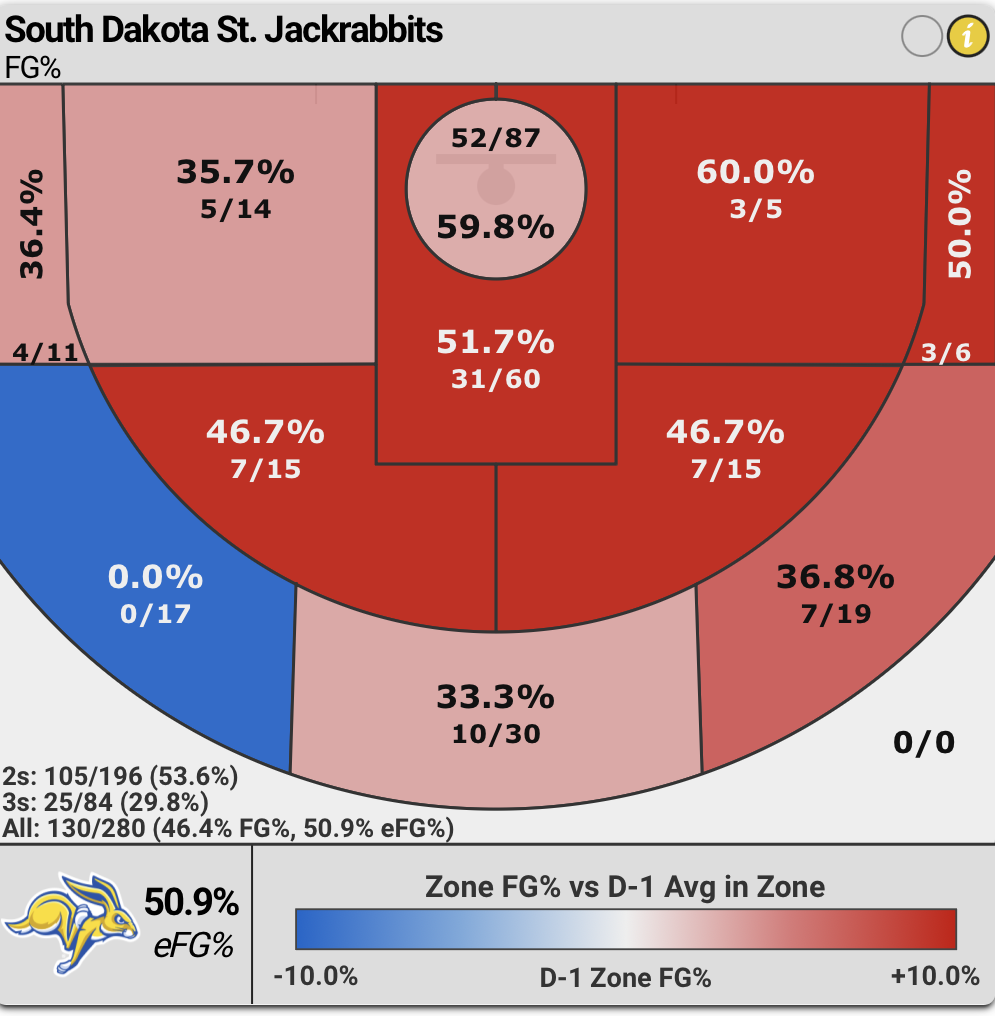 If Washington overhelps on Meyer, the Jackrabbits can turn her post gravity into clean and efficient perimeter looks. Therefore, the Huskies’ best defensive possessions may look boring: hold your spot, contest without fouling, rebound, and run.
If Washington can force Meyer into kick-outs that become merely “good shots” instead of “great shots,” the Dawgs can live with that basketball math.
The Three-Point War: Closeouts and Consequences
This matchup could swing on the deep arc because South Dakota State’s shooters punish even small mistakes. Madison Mathiowetz, a 5’10” senior guard, hits 40.1% from three while scoring 13.6 points per game;
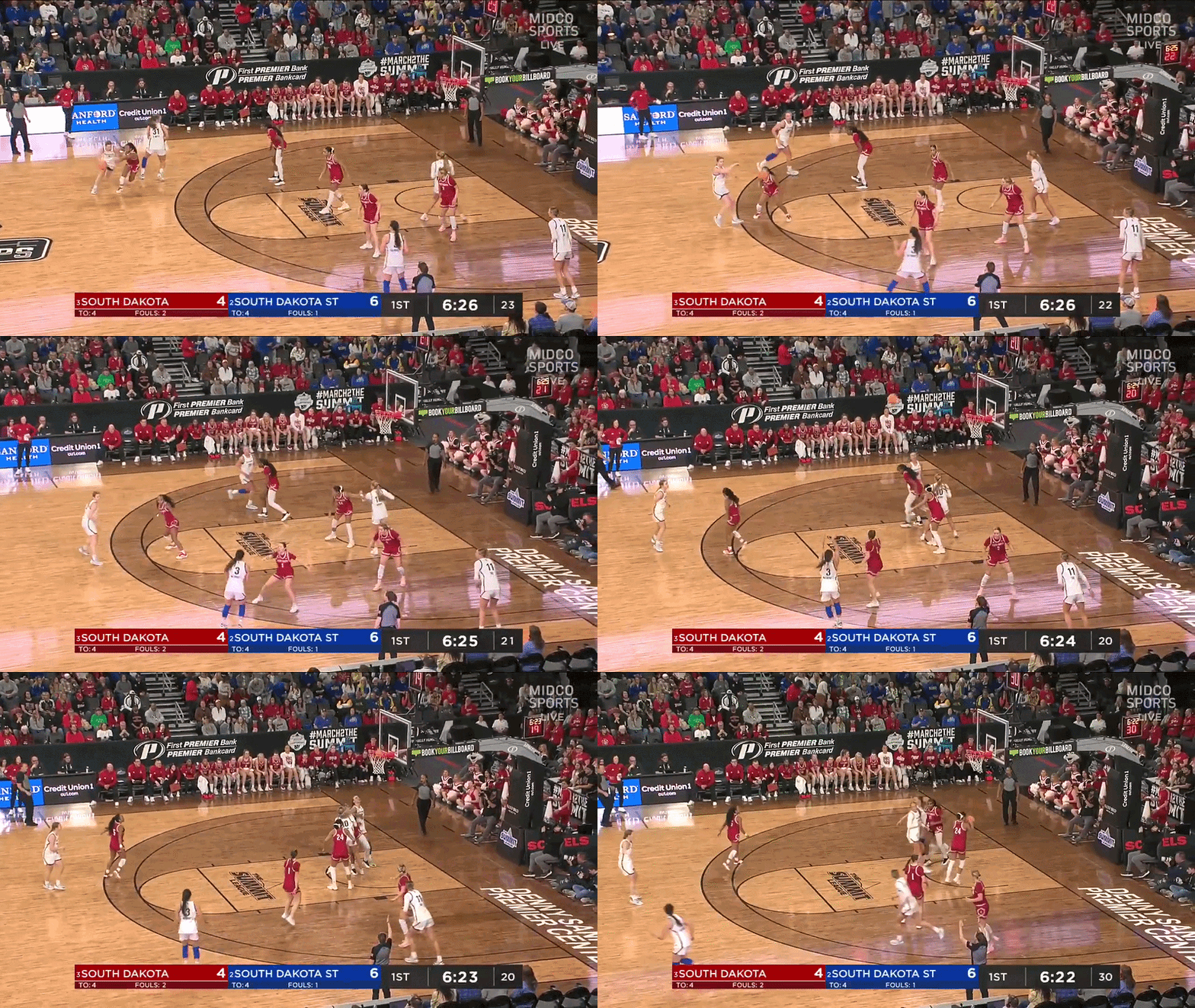 and 5’8″ sophomore guard Emilee Fox is a three-point specialist who can change scoring margins quickly at 47.7% from deep.
 With SDSU shooting 35.1% from three as a team, Washington cannot treat perimeter defense as optional help defense.
At the same time, Washington’s own perimeter spacing can bite back. The Huskies get 30.9% of their points from three and shoot 34% from deep, while Howell’s 41.9% mark is a matchup stress test. If UW hits early threes, it can pull South Dakota State’s bigs and defensive helpers a half-step farther from the paint—exactly the breathing room Sellers needs to live at the rim and the free-throw line area.
X-Factor Triangle: Ladine and McGaughy vs. Fox
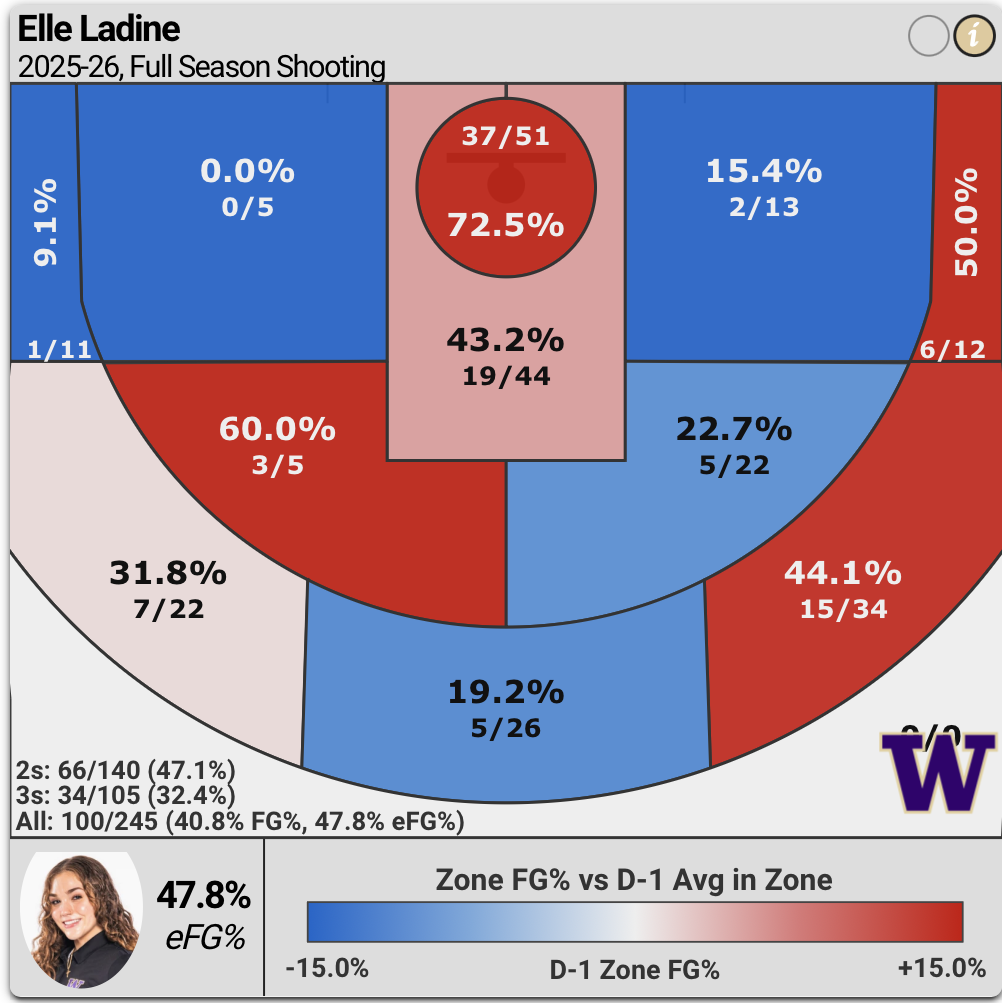
Elle Ladine, a 5’11” senior wing/guard is Washington’s fiery accelerant, and March often rewards the player who can swing two minutes of basketball. She averages 10.4 points, 5.0 rebounds, and 2.0 assists, and she plays a tournament-friendly style: physical drives, rebounds in traffic, and timely shots. Although her percentages (47.1% on twos, 32.4% from three) suggest some efficiency variance, that variance can become a weapon if she hunts and attacks good shots decisively instead of settling.
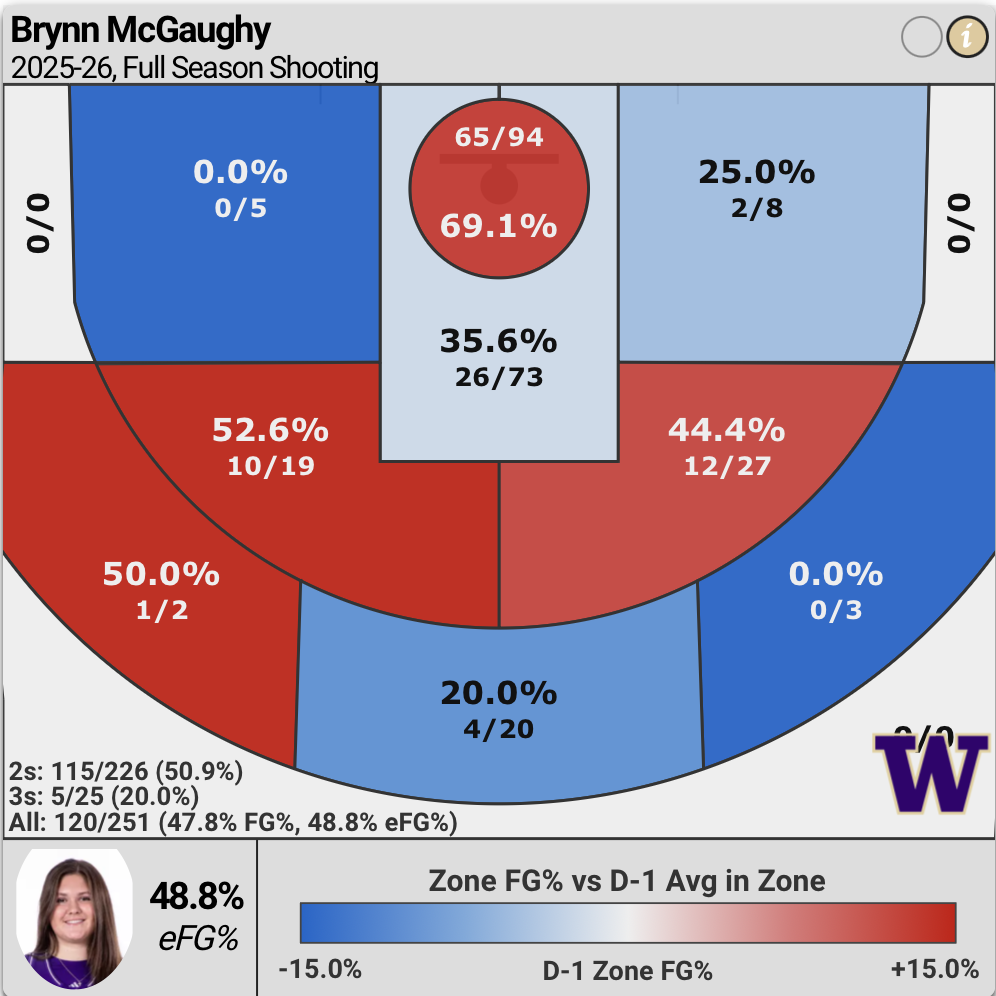
 Brynn McGaughy gives UW a different kind of swing. The 6’3″ freshman forward contributes 9.0 points and 1.1 blocks, and her length allows Washington to mix coverages without completely surrendering the paint. If McGaughy can absorb minutes on Meyer, contest without fouling, and still run the floor, she can keep the Huskies’ defensive identity intact while preserving Howell and other defenders for winning-time possessions.
 On the other side, Emilee Fox is SDSU’s silent backbreaker. Fox is an elite floor‑spacer that stretches defenses with deadly three-ball accuracy, and she moves well without the ball, thriving in SDSU’s motion sets. Washington cannot afford to lose her on kick‑outs — she punishes overhelping and late rotations.
The Shot-Quality Chess Match: Threes, Twos, and Discipline
It bears repeating, both teams defend the three at 28.9% allowed, which sets the stage for a game where attempt quality matters as much as percentage. Washington will want Howell and Sellers generating clean looks—catch-and-shoot threes for Howell, paint touches for Sellers, and matchup advantage attacks for Elle Ladine (open threes or dribble-drives). However, UW can’t fall in love with tough pull-ups, because South Dakota State’s defense holds opponents to 37.8% shooting overall.
On the other end, Washington must respect SDSU’s inside-out balance. The Jackrabbits get 55.6% of their points from two-point range, the same share as UW, and they pair that with efficient spacing. Consequently, Washington’s closeouts must stay under control. The Huskies can’t trade a contested Meyer two for a wide-open Fox three; they must force SDSU into the in-between shots that don’t naturally appear in its system.
The Dawgs’ Blueprint: Five Practical Paths to Victory over SDSU
First, UW needs early perimeter aggression to take advantage of superior guard length and athleticism, by setting tempo with Sellers and Howell (and Ladine, if locked in). If Sellers can set the tone early with Dawgs guards attacking mismatches and pushing pace off every defensive rebound, it will make South Dakota State “speed up” their natural pace– what feels like chaos will become a problem the Jackrabbits can’t solve in 40 minutes.
Second, Washington must win the “possession battle” i.e., valuing the ball (15.1 turnovers is the danger zone) while still playing assertive. The Huskies thrive when they force turnovers and turn games into athletic battles. SDSU, however, commits just 13.5 turnovers per game and plays with remarkable poise. If Washington can’t create chaos, SDSU’s efficiency becomes overwhelming.
Third, UW must win the rebound battle with purpose. Both teams sit around 39 rebounds per game, but the key could be which rebounds— i.e., if Washington’s defensive boards can limit SDSU to one-shot possessions , while UW’s offensive boards increase their own possessions it will greatly reduce SDSU’s efficiency advantage.
Fourth, the Huskies must protect the paint without overhelping. SDSU’s spacing is designed for interior efficiency that can lead to open perimeter looks that punish late rotations — . SDSU shoots 35.1% from three, so Howell and McGaughy (plus 6’5″ graduate center Yulia Grabovskaia) must hold up against Meyer without constant doubles.
Fifth, Washington must defend without gifting points at the line or through rotational; breakdowns. If UW stays defensively poised within their scheme, contests shots with discipline, and turns some defensive stops into transition opportunities, the Dawgs can turn this first-round matchup into exactly what they want: a fast, physical game where two-way efficiency creates pressure and a big payoff.
UW WBB Huskies Win Probability: 67%
GO DAWGS!


