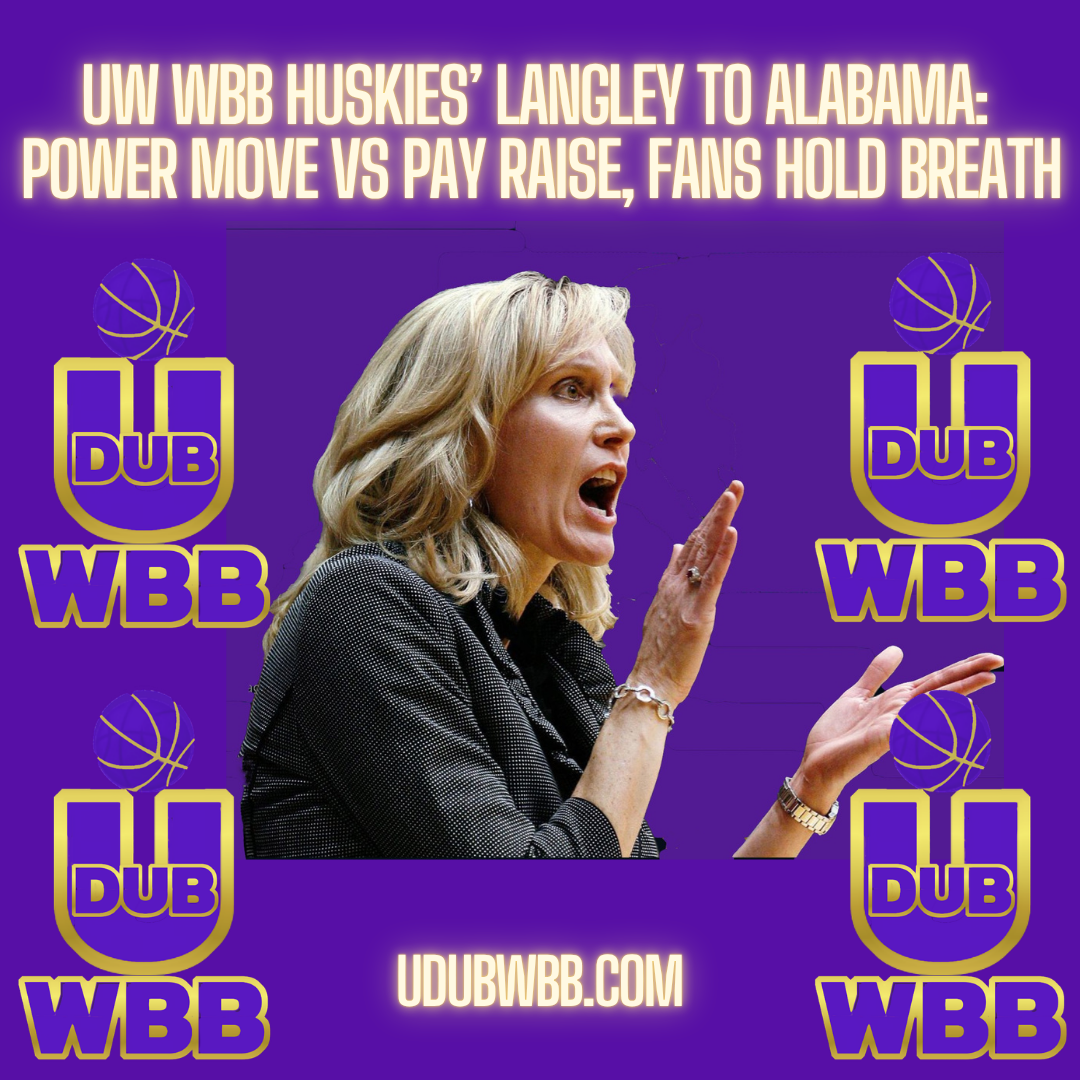
From Rebuild to Relevance—What Langley Has Built at UW Tina Langley didn’t just stabilize Washington women’s basketball—she reintroduced the Huskies as a program that expects to matter in March. In five seasons, she flipped the script from a 7–16 start in 2021 into a 22–11 campaign in 2025, and the Dawgs came within a single overtime possession of pushing deeper into the NCAA Tournament. That kind of trajectory doesn’t stay secret for long.
Along came the University of Alabama, according to rumors, looking to hire Langley away from Washington. And, moreover, the timing couldn’t be more delicate. Washington has finally stacked continuity with credibility: a coach who develops talent, recruits aggressively, and wins enough to turn “hope” into “expectation.” As a fan, it feels like the program is no longer begging for attention—it’s earning it. And that’s exactly when other schools start calling.
Why Alabama Opened the Door—and Why Langley’s Name Walked Through It Alabama (Bama) suddenly has a high-profile vacancy after Kristy Curry left for South Florida. That move came right after the Alabama Crimson Tide’s Round of 32 exit to Louisville and capped a stretch of four straight NCAA Tournament trips. In other words, Bama isn’t shopping for a rebuild; it’s shopping for the next step.
Then there’s the personal pull. Langley grew up in Jasper, Alabama, about an hour from Tuscaloosa. She holds deep ties to the state—Hall of Fame recognition at West Alabama as a player, plus a master’s degree from Alabama. So even if the job is “just another opening” nationally, it reads like a potential homecoming locally. Consequently, it’s not surprising her name reportedly surfaced on a short list.
The Money Questions—Buyouts, Budgets, and the NIL Reality Here’s where fans get nervous, because rumors become real when the math works. Reports have highlighted a buyout figure that becomes more manageable soon—one widely shared Mitchell Northam tweet on X.com pegged it at roughly $175,000 after April 1st, which would make a move financially easy if Alabama wants to act fast. Separately, other contract reporting has described different buyout terms over longer horizons. Regardless of which specific trigger date proves most relevant, the core point remains: the buyout conversation is happening, and that alone raises the temperature. The same source confirmed that Tina Langley is scheduled to make $700,000 at Washington next season.
However, Alabama’s own resource picture complicates the narrative. The reporting around ex-Bama coach Kristy Curry’s exit to the University of South Florida suggested the move wasn’t strictly about salary ($700k per year according to TuscaloosaNews.com article on 07/07/25;ironically, the same as Langley)— instead it was about revenue share and NIL resources for the program. It was also reported on AL.com that Alabama ranked last in the SEC (excluding private Vanderbilt) in women’s basketball spending at about 5.4 million in 2025.
Meanwhile, USA Today reporting cited the most recent Equity in Athletics Data Analysis(FY2024) that put Alabama around $5.5 million and Washington near $6.9 million. So while Bama carries brand power, UW currently looks better positioned to fund winning at scale.
Why Montlake Still Makes Sense—Roster Continuity and a Rising Ceiling Washington’s pitch isn’t theoretical anymore; it’s visible on the floor and in recruiting wins. Washington’s projected roster retains all-conference-level talent like Sayvia Sellers and Avery Howell. UW also returns proven five-star forward Brynn McGaughy; and promising young talent in guard Devon Coppinger, Australian point guard Sienna Harvey and four-star 2025 recruit Nina Cain, and . That’s not luck—Langley built it.
Additionally, the “stay” argument isn’t only about dollars; it’s about fit and momentum. Sellers (Anchorage), Howell (western Idaho), and McGaughy (eastern Washington) all carry regional ties. That matters because elite teams don’t just recruit stars—they keep them. If Langley stays, Washington enters next season with returning cornerstone talent and a roster that looks built to climb in the Big Ten. If she leaves, the portal era guarantees uncertainty, and the next coach could inherit a roster in motion.
The Fan’s Plea—Pay the Coach, Protect the Program From a Washington fan perspective, this rumor hits a familiar nerve: build something special, then watch a bigger-name conference program try to pry it away. The Huskies have lived this movie before, and Dawgs fans don’t want a rerun—especially not when the foundation finally feels strong. Langley has coached at Toledo, Clemson, Georgia, Maryland, and Rice before UW, and she has spent decades away from Alabama. Yet Bama’s pull is real, and the opening is real, which means UW can’t afford to be passive.
Therefore, the answer feels straightforward: Washington should move now with an extension, a raise, and a resource plan that matches its ambition. If Alabama can offer the “home” narrative, UW needs to counter with the “future” narrative—built around stability, NIL support, staffing, and a clear commitment to chasing championships in the Big Ten. If UW values this momentum, it should prove it in writing—before the rumor becomes a resignation press conference.
The Cold Math: Weighing Tina Langley’s Value in Washington’s New Era Washington is right to consider a pay raise for Tina Langley, and the logic starts with momentum. Under Langley, the UW women’s basketball program has stabilized, improved, and regained relevance in March. That progress matters in a Power 4 environment where competitive consistency drives recruiting, ticket sales, donor confidence, and national perception. Therefore, a raise isn’t just a reward; it is a retention tool that signals seriousness about keeping the Huskies on an upward track.
However, Washington also has to price performance accurately. A Round of 32 finish is respectable, yet it typically doesn’t justify an “elite-tier” contract. That’s the cold math of major college athletics: elite money usually follows elite outcomes—Sweet 16 runs, conference titles, and sustained national contention. Consequently, while Langley has proven she is a good coach, Washington must decide whether she has proven she is an elite one. The difference between “good” and “elite” is exactly what turns a smart raise into an expensive mistake.rice
Smart Structure: Pay More, Incentivize More, Protect UW–No Million Dollar Price Tag The most strategic path is a significant raise paired with a contract extension and performance-based incentives. In other words, UW can pay Langley competitively now while tying top-end earnings to measurable achievements.
For UW Athletic Director Chun, a $100,00 – $150,00 base pay raise should be the limits of fiscal responsibility — a guaranteed $800k to $850K a year to stay at Washington is nothing to sneeze at (or be offended by). Then, for example, Washington could reward Sweet 16 appearances, top-tier recruiting classes, and conference contention with escalators and bonuses. As a result, the program shares upside with the coach without locking itself into an SEC-sized salary before the Huskies consistently reach that tier.
Just as importantly, an incentive-heavy contract helps Washington compete financially without pretending it has to match Alabama dollar-for-dollar. For example, an SEC-level base pay raise to around $1 Million per year will likely not align with Washington’s budget priorities, especially if the on-court résumé hasn’t reached the “annual contender” standard. Nevertheless, that doesn’t mean lowballing the coach. It means building a deal that respects progress, encourages the next step, and keeps the department flexible. When the Dawgs break through, the contract can scale up—by design.
Leverage, Loyalty, and the Reality of the Coaching Market Washington should also recognize the wider coaching marketplace. There are other capable coaches who would gladly take the Washington women’s basketball job, which gives UW some leverage in negotiations. Still, leverage cuts both ways. If Langley continues to build, other programs will call, and losing a coach mid-ascent can set a program back years. Therefore, UW’s goal should be stability—without overcommitting early.
At the same time, it’s fair to ask whether Tina Langley would truly walk away from a program on the cusp of a breakthrough. Coaches spend careers trying to reach the moment Washington is approaching: a roster that can push from “tough out” to consistent Sweet 16 threat. Meanwhile, starting over elsewhere—such as Alabama—doesn’t guarantee deeper tournament runs. In fact, a coach can trade a promising situation for a tougher rebuild and end up stuck at the same Round of 32 ceiling. That’s why the smartest outcome is mutual: Washington pays Langley more, Langley stays to finish the climb, UW invests more money in the women’s basketball program overall, and the Huskies aim to turn potential into championship hardware.