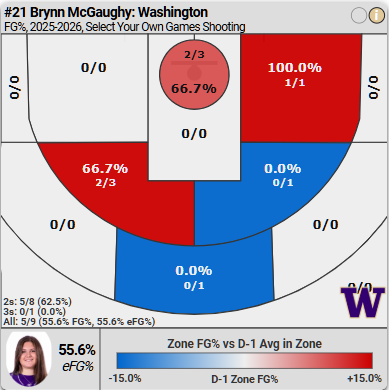
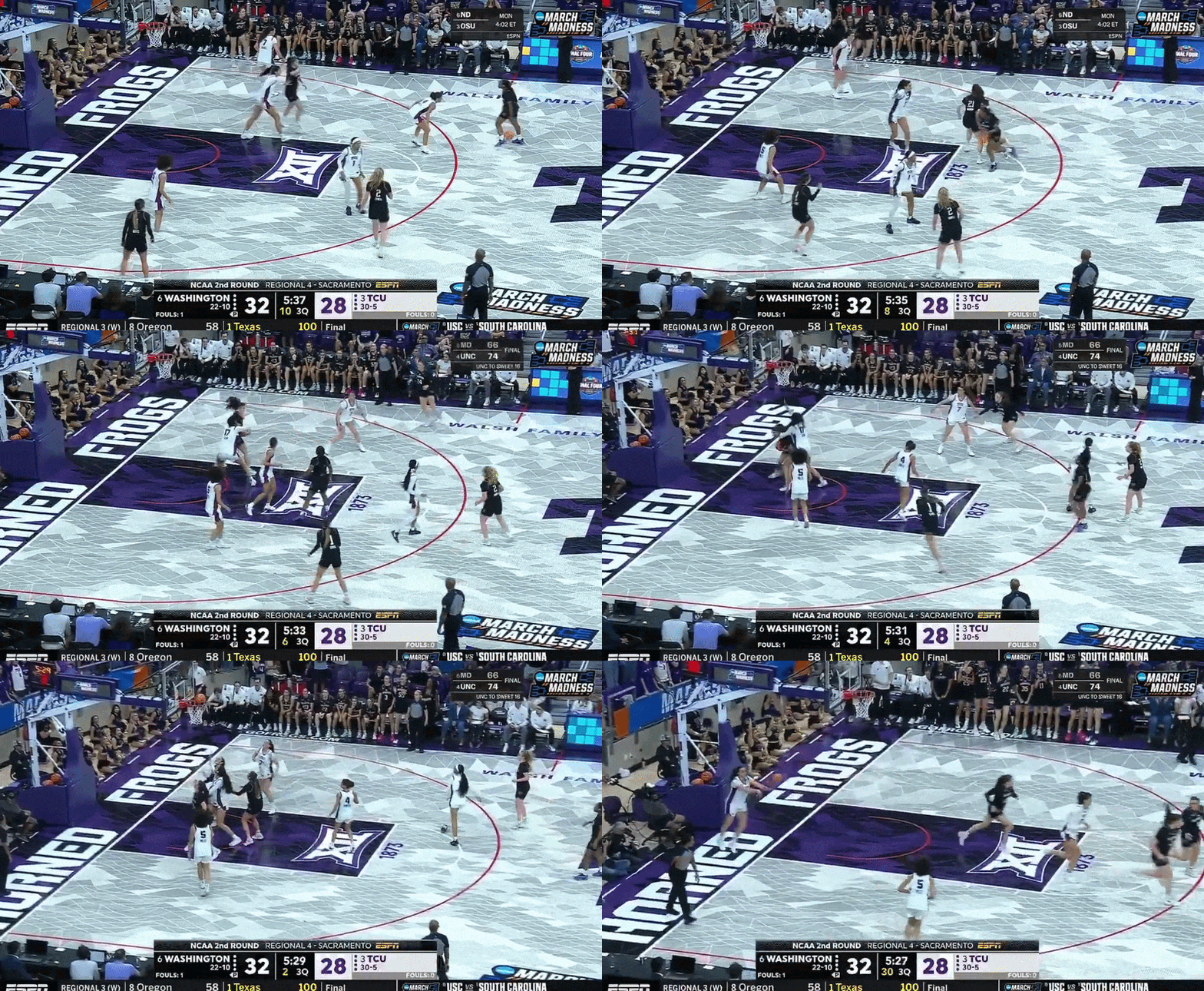
Washington’s season ended in a 62–59 overtime loss to TCU in the second round of the NCAA Tournament. The Huskies controlled long stretches of the game, defended well, and held a late lead, but their struggles finishing at the rim and a scoreless start to overtime proved decisive.
Washington forced 10 turnovers, limited TCU to 4-of-19 from three, and kept the pace to just 61 possessions — exactly the type of game they needed.
But the Huskies were outscored 42–18 in the paint and converted only 46.7% of their attempts at the rim, a key factor in a matchup decided by three points.
Despite strong performances from Avery Howell, Sayvia Sellers, and freshman Brynn McGaughy, Washington couldn’t generate enough efficient offense late, and TCU capitalized in overtime to advance to the Sweet 16.
Washington did almost everything right — except finish at the rim, which significantly hurt their halfcourt execution in the closing minutes.
The Game Washington Wanted — Slow, Gritty, and Defensive
The Huskies entered the matchup knowing they couldn’t let TCU turn the game into a track meet. And they succeeded. The pace settled at 61 possessions, one of the slowest tempos Washington played all season. That alone kept the game within reach.
Washington’s defensive effort was undeniable:
10 turnovers forced
8 steals
Only 12 turnovers committed
A defensive rating of 90.4, strong enough to win most nights
The Huskies’ hands were active, their rotations sharp, and their ability to disrupt passing lanes kept TCU from ever finding a rhythm from deep. The Horned Frogs shot just 4-for-19 from three (21.1%), a testament to Washington’s perimeter discipline.
But while Washington won the chess match outside, the battle inside told a different story.
The Paint Problem That Defined the Night
The most glaring statistical contrast — and the one that ultimately doomed Washington — was the scoring inside the arc.
TCU in the paint:
42 points
22-for-41 on 2s (53.7%)
Washington in the paint:
18 points
14-for-37 on 2s (37.8%)
That’s a 24‑point deficit in the most high‑value area of the floor.
But the deeper issue wasn’t just volume — it was finishing. Washington struggled mightily at the rim, converting just 46.7% (7 of 15) on close attempts.

TCU, by contrast, finished 63.2% (12 of 19) at the rim. In a game decided by three points, that gap was enormous.
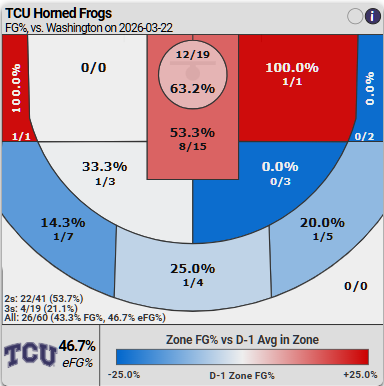
Every missed layup, every altered finish, every rushed attempt added up. Washington created opportunities at the basket, but TCU’s length and physicality forced the Huskies into tough angles and off‑balance releases. The Frogs didn’t just protect the rim — they dictated it.
Washington’s 41.9% effective field goal percentage reflects that struggle. They simply had to work harder for every basket, and the rim — the place where efficiency is supposed to live — became a source of frustration instead of relief.
The Three‑Point Line: Washington’s Lifeline
If Washington had any offensive salvation, it came from beyond the arc.
8-for-25 from three (32%)
Nearly 40% of Washington’s shots were threes
Washington shot better from three than from two
The Huskies needed those threes to survive TCU’s interior dominance. Every time the game threatened to tilt, Washington found a perimeter answer — a rhythm three off a drive‑and‑kick, a pick‑and‑pop jumper, a transition pull‑up.
But relying on the three is a dangerous way to live in March. When the shots dried up late, Washington had no reliable counter inside.
Rebounding: The Hidden Swing Factor
The rebounding numbers weren’t catastrophic, but they were costly.
TCU:
35 defensive rebounds
7 offensive rebounds
Washington:
28 defensive rebounds
7 offensive rebounds
The offensive boards were even, but the defensive rebounding gap mattered. TCU’s extra possessions didn’t come in volume — they came in moments. A late offensive rebound here, a reset there, a second‑chance bucket that halted Washington’s momentum.
Washington’s 80% defensive rebound rate was solid, but TCU’s 83.3% was better. And in a three‑point game, “better” was enough.
Turnovers: A Rare Washington Advantage
One of the most encouraging signs for Washington was their ball security.
10 turnovers
13.1% turnover rate
11 points off turnovers
TCU, meanwhile, committed 12 turnovers and scored only 9 points off Washington mistakes.
This was one of the few statistical categories Washington won outright. It kept them in the game. It gave them transition chances. It allowed them to control tempo.
But it wasn’t enough to offset the shooting gap.
Bench Production: An Expected Advantage That Never Materialized
All season, Washington’s bench had been a quiet but reliable source of separation, averaging 9.2 points per game and often providing the spark that stabilized long stretches. Against TCU, that edge simply never appeared.
Both teams finished with just 2 bench points, a statistical stalemate that played directly into the Horned Frogs’ hands. Washington needed its depth to tilt the margins in a low‑possession, grind‑heavy matchup, but the Huskies never found the supplemental scoring that had buoyed them throughout the year.
Instead of being a pressure point Washington could exploit, bench production became a wash — and in a three‑point overtime loss, that missing advantage loomed large.
Avery Howell Sets the Tone: A First‑Half Clinic That Put Washington in Control
Before the game tightened into a possession‑by‑possession grind, Washington’s early foothold came from the steady hands — and hot shooting — of Avery Howell. The sophomore forward delivered one of her most complete halves of the season, anchoring Washington on both ends and giving the Huskies the confidence to punch first.
Howell was everywhere in the opening twenty minutes. Defensively, she was a constant irritant: jumping passing lanes, bodying up in the post, and disrupting TCU’s rhythm before it ever formed. But it was her offense that truly shifted the game’s energy. Howell knocked down three of her five first‑half attempts from beyond the arc, stretching TCU’s defense and forcing the Frogs to guard Washington in uncomfortable space.
Her shooting wasn’t just efficient — it was timely. Each make arrived at a moment when Washington needed a stabilizer, a momentum‑keeper, a reminder that they belonged in control. By halftime, Howell had 11 points, leading all scorers and serving as the engine behind Washington’s early lead.
And then, just as suddenly, she vanished from the shot chart.
Despite her first‑half dominance, Howell attempted only one field goal in the entire second half — in part because the UW coaching staff failed to scheme Howell open after TCU clearly made half-time adjustments to limit her three-point opportunities.
Whatever combination of TCU’s defensive adjustments, Washington’s shift in offensive flow, or simply the chaos of a tight March game, the Huskies never rediscovered the version of Howell who had carried them early.
She finished with 14 points on 60% shooting from three-point range: eight rebounds; and three assists — a strong line, but one that undersells how vital she was before the game tilted.

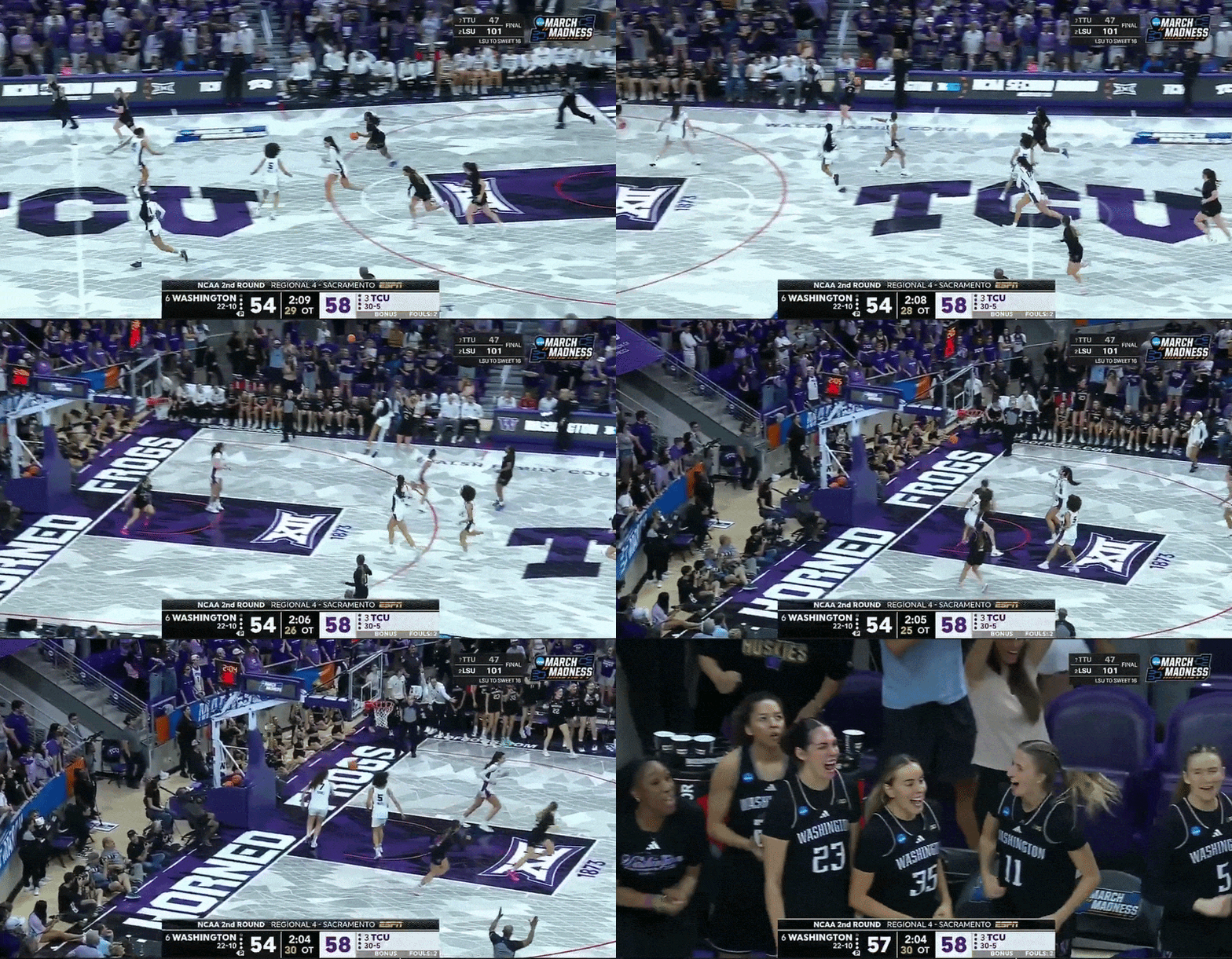 Washington’s early control was built on Howell’s confidence and versatility. Losing that presence after halftime became one of the quiet turning points of the night.
 Her fearlessness showed most in the final moments of overtime, when she rose for a potential game‑tying three that would have forced a second extra period. The shot was clean, confident, and on line — the kind of look you want in the hands of your best scorer — but it drifted just long as the horn sounded.