Shock Hosting Shock Hosting
  • ABOUT UDUBWBB.COM
  • CONTACT
  • COOKIE POLICY
  • DISCLAIMER
  • HomeCourt
  • PRIVACY POLICY
  • TERMS OF SERVICE
No Result
View All Result
No Result
View All Result
UDUBWBB.com
No Result
View All Result
Home #UDUBWBB

March Madness 2nd Round Preview: UW WBB Huskies vs TCU – Sun. March 22nd @7PM PST

A Clash of High Octane Offense vs Suffocating Defense

by Nesto Roland
March 22, 2026
in #UDUBWBB
Reading Time: 9 mins read
March Madness 2nd Round Preview: UW WBB Huskies vs TCU – Sun. March 22nd @7PM PST

On March 22, 2026, Washington Huskies (22–10) arrive to the NCAA Tournament’s second round fresh off their first tourney win since 2017 ready to continue asserting an identity that has reenergized their program: disciplined defense, efficient controlled offense, and a backcourt with star power that can seize the moment when the game is on the line.

Yet, this game is not simply about what UW does well—it’s also about what it must do to survive. The TCU Horned Frogs(30–5) bring one of the nation’s toughest tournament-ready profiles: explosive scoring plus suffocating defense, and a talented roster built to create and punish defensive mistakes with quick scoring runs. For the Dawgs, the assignment is clear: keep the game under control, keep the floor spaced, and turn every possession into an efficient, quality opportunity.
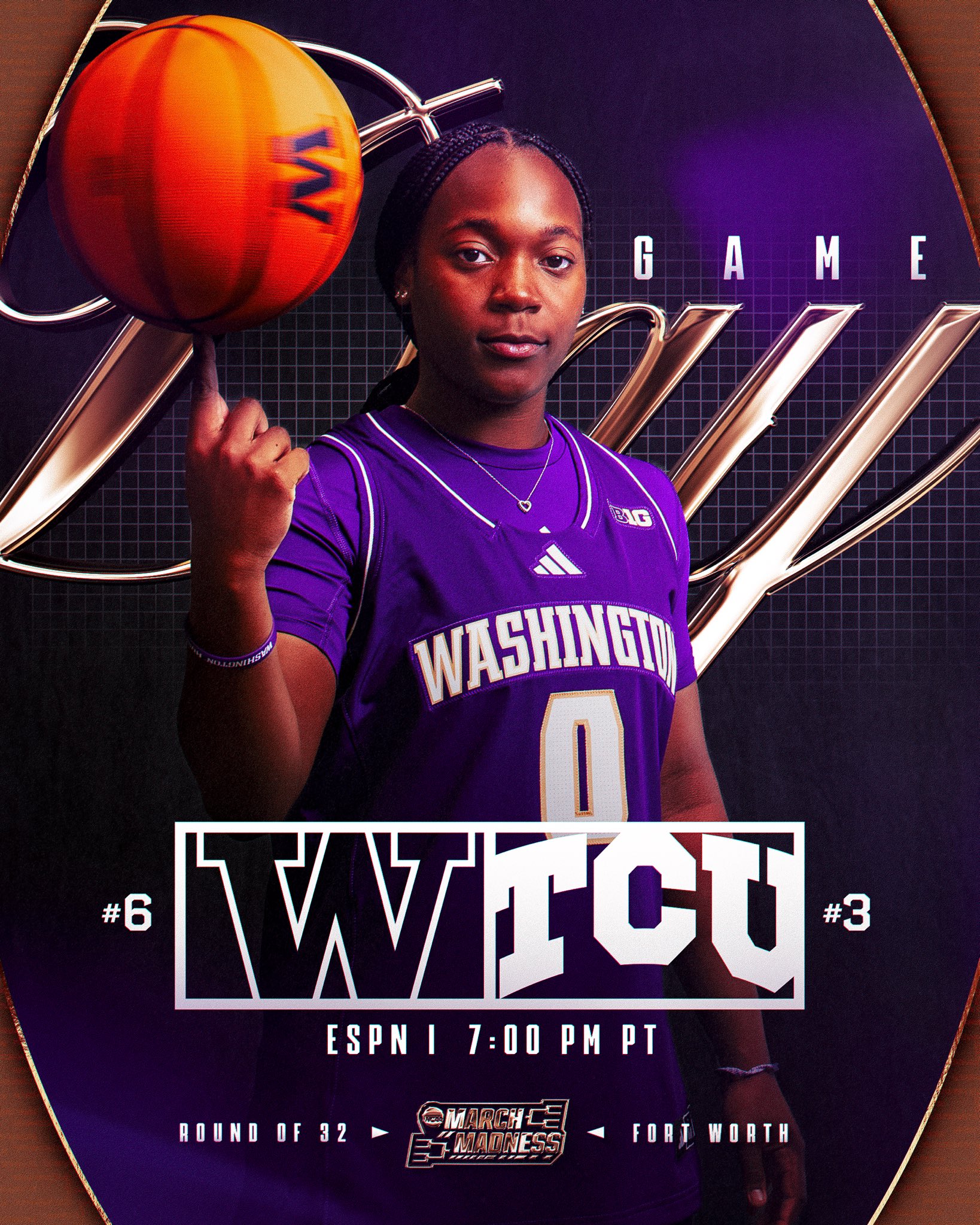
Courtesy of UW Athletics

The Tempo vs. Shot Efficiency Tug of War
At a glance, the contrast is immediate. Washington scores 71.7 points per game while limiting opponents to 62.0 points on40.5% shooting and 29.1% from three-point range. UW’s defensive consistency pairs with an offense that shoots 44.8% overall, including 34.1% from deep, 50.7% inside the arc and 64% at the rim— cool, efficient offense at every level, not frantic.

Meanwhile, TCU plays faster than UW: 70.7 offensive possessions per 40 minutes vs. Washington’s 68.5 possessions; scoring 77.8 points per game, and only allowing 55.9 points — while shooting 35.8% from three-point range and 46.7% inside the arc (although TCU has subpar 48.8% efficiency at the rim).

The Horned Frogs defense squeezes opponents to 33.4% shooting overall and a mere 26.6% from three-point range, and they protect the rim with 5.3 blocks a night.

As a result, this basketball matchup becomes a tug-of-war: if UW can reduce the game to half-court sets and deliberate decisions, the matchup tightens up; if TCU turns it into a free-flowing sprint, the scoring margin could increase quickly (unless UW can speed up without losing efficiency).

Sayvia Sellers: The Spark and Tempo-Setter of UW’s Offense
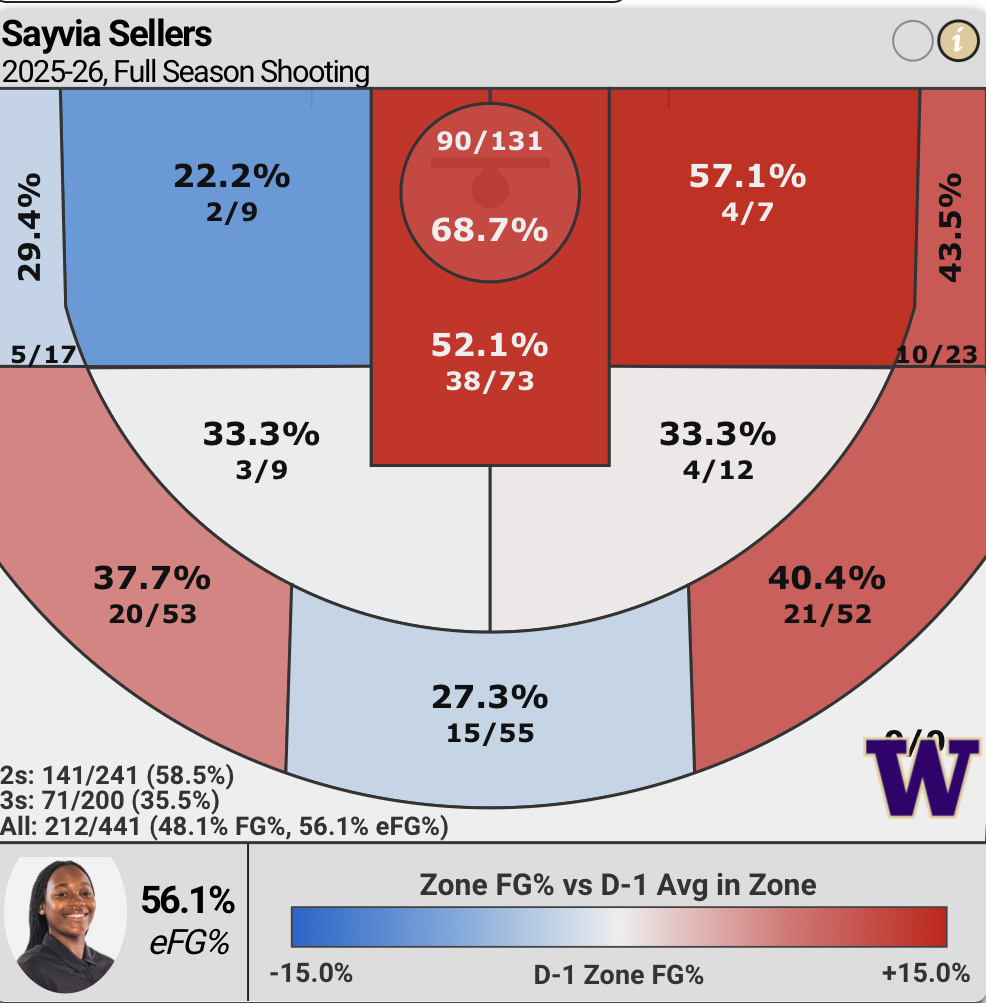
Washington goes as far as Sayvia Sellers takes them. The 5’7″ junior point guard averages 18.0 points and 3.9 assists, and she scores with rare efficiency for a high-responsibility creator—58.5% on twos, 35.5% from three and 68.7% at the rim. Just as important, Sellers dictates how fast UW plays by applying the gas and brakes based on the scenario.

Against TCU, Sellers’ value-added increases exponentially. The Horned Frogs will want to pressure Washington’s offensive decision-making; Sellers must answer (and dominate the ball when necessary) with poise and pacing. If she turns ball screens into paint touches without donating forced turnovers, Washington can tap into it’s best efficiency profile: 36.3 points in the paint plus kick-out threes for timely quality looks. Defensively, Sellers provides 1.6 steals that creates selective disruption to keep a high-octane TCU offense from getting too comfortable.

Avery Howell: Efficient Two-Way Wing Game-Changer
If Sellers is the spark for the engine, 6’0″ sophomore wing-guard Avery Howell is the turbo that can quickly increase UW’s energy with power (rebounds) and elite shooting efficiency. Howell averages 14.2 points and a massive 8.3 rebounds per game, and she does it with premium efficiency: 64.1% on two-point attempts and an elite 42.7% from three. Fresh off a 30-point first round performance, Howell is a offensive force that TCU must account for and deal with in their gameplay.

Howell’s rebounding is a key factor to a Washington victory. TCU grabs 41.7 total rebounds per game, including 30.7 defensive rebounds. Howell’s ability to individually end opponent’s possession with a defensive rebound; and extend Washington’s possessions with an offensive rebound is crucial to this matchup. Howell’s rebounding prowess can keep the game tempo in UW’s preferred range and reduce the number of TCU transition possessions where Horned Frog shooters become most dangerous.

Olivia Miles: Triple Double and Mismatch Creator
Washington defensive numbers are strong, but 5’10” TCU point guard Olivia Miles is the type of player who tests a defensive system’s seams. Miles averages 19.4 points, 7.1 rebounds, and 6.6 assists with the power and court vision to get to the paint and expose any error in a defensive rotation.

The Huskies’ first job is set an early wall and simultaneously cover TCU shooters to prevent the drive-and-kick threes and quick-hitter trail threes that the Horned Frogs feast on.

If UW contains Miles early in the shot clock, while denying quick and easy perimeter looks, they can create a possession-by-possession battle that favors disciplined patience over free-flowing tempo and pace.

Marta Suarez: Versatile Big Breaking Defensive Coverages
TCU’s 6’3 frontcourt star Marta Suarez posts 17.1 points and 7.3 rebounds, while stretching the floor at 37.5% from three-point range and scoring inside with 61.5% efficiency at the rim. Suarez can post-up and punish defensive switches and help defenders; as well as, score in the pick-and-roll or with. a pick-and-pop jumper

“Marta Suarez tonight 🔥 • 24 points • 10 rebounds • 10/17 FG https://t.co/znjqlMQre3” / X

Washington allows opponents only 29.1% efficiency from three, but Suarez’s elite 3-point shooting forces opposing bigs to defend farther from the rim than they want. If the Dawgs frontcourt is drawn outside by her perimeter threat, then driving lanes open for Miles; but if they sit back, Suarez gets clean three-point looks. Washington’s best defensive rotation discipline will be required to contest and defend Suarez without over-helping.

The Elite Point Guard Chess Match: UW’s Sayvia Sellers vs. TCU’s Olivia Miles
The spotlight in the Huskies vs. Horned Frogs showdown inevitably falls on the battle of elite point guards. Olivia Miles,TCU’s do-everything conductor, versus UW’s explosive spark (but still efficient), Sayvia Sellers — unless they play to a standstill, this promises to be the major determining factor of the game’s outcome.

The 5’7″ Sellers wants to play off of ball screens, force TCU’s defense to chase, then punish their smallest mistake by turning the corner and getting downhill to a midrange jumper, a quick kickout pass for three, a rim finish; or punishing defenders that go under ball screens with a deep three-ball of her own.

On the other hand, Miles is a triple double queen that impacts possessions without scoring big, by using her tempo to attack defensive mistakes. Miles uses her size and physicality to absorb contact from physical defenders, keep her dribble alive, and still finish the play. Plus, Miles’ rebounding from the guard spot can provide extra transition opportunities which opens the court for TCU’s shooters by creating defensive rotation chaos.

Defensively, Sellers is disruptive on-ball at the point of attack (1.6 steals) or reading passing lanes. Conversely, Miles uses her size and physicality to cut off driving and passing lanes.

Ultimately, the competitive matchup is even—if not a slight lean toward TCU, only because Miles, the former Notre Dame guard, has the advantage of extensive NCAA Tournament experience. Still, if Washington can keep the game in a half-court rhythm, Sellers’ efficiency and shot creation give the Huskies a competitive path to securing a close victory in the final minutes.

X-Factors: Ladine and McGaughy vs. Hunter and Bigby Could Decide a Close Game
Stars may set the table in March; but X-factors can flip the table over and change the best-laid game plans. For Washington, 5’11 senior wing-guard Elle Ladine (10.2 points, 5.0 rebounds, 2.1 assists) brings streaky but explosive scoring capability from three-point range and physical dribble-drives to the paint against overly aggressive defenders.

Meanwhile, 6’3″ freshman forward
Brynn McGaughy (9.2 points, 1.1 blocks) supplies rim presence and efficient finishing at the rim—that matters against an elite rim-protecting TCU squad and the interior offensive presence of TCU’s 6’3″ forward Marta Suarez.

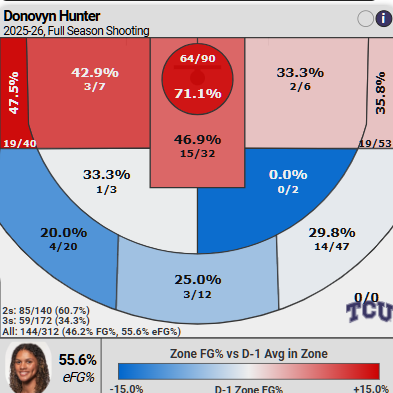
For TCU, they have perimeter shooting threats that can spark scoring runs. 6’0″ junior guard Donovyn Hunter hits an elite 47.7% from three;

while 6’1″ senior guard Taylor Bigby shoots 39.5% from deep and 55.1% on two-pointers and scored 27 points in the first round of the NCAA

— meaning UW’s defensive closeouts must be both quick but under control. If UW helps one step too far, Hunter and Bigby can turn a good defensive possession into a sudden scoring swing.

How Washington Makes It a Husky Game: The Blueprint for 40 Minutes
The clearest path for Washington starts with controlling game tempo. UW doesn’t need to play slow for the sake of slow; it needs to play organized. That means valuing the ball (Washington averages 14.9 turnovers) and refusing to allow easy runouts to a TCU team that scores 14.0 points off turnovers. The Huskies must also emphasize “one shot and out” defense—because TCU’s rebounding edge and shot blocking can create second chances that creates game flow favoring the Horned Frogs.

UW must also keep its offensive spacing and make deliberate decisions early enough in the clock to get quality shots. Washington gets 31.1% of its points from three and 55.4% from two, so their best possessions will likely feature Sellers turning the corner and imploding TCU’s defense, Howell punishing TCU help defenders from the deep perimeter, and the Huskies bench (a strong 17.6 bench points per game) providing significant contributions without forcing it.

If the Dawgs can carry the game into the fourth quarter within close striking distance (one or two possessions), UW’s half-court discipline at both ends gives them a real chance to defeat TCU and March forward to the third round.

UW Huskies Win Probability: 37%

GO DAWGS!

facebookShare on Facebook
TwitterTweet
FollowFollow us
Tags: FeaturedFeatured - Editor's Picksticky
Twitter Instagram

@UDUBWBB is UW WBB

Welcome Back!

Login to your account below

Forgotten Password?

Retrieve your password

Please enter your username or email address to reset your password.

Log In

Add New Playlist

No Result
View All Result
  • HomeCourt
  • CONTACT
  • ABOUT UDUBWBB.COM
  • COOKIE POLICY
  • DISCLAIMER
  • TERMS OF SERVICE
  • PRIVACY POLICY

© 2020UDUBHoops.com - Website Design & LogosCreativeGeniusTech.