The Washington Huskies (11–2) welcome the #6 Michigan Wolverines (11–1) to Hec Edmundson Pavilion on Thursday at 3 p.m. PST, in what could be a defining moment for both teams’ NCAA Tournament resumes.
For the Dawgs this is more than a ranked-vs-ranked B1G 10 conference showdown; it’s also a measuring stick for how far the program’s uptempo, modern playing style (which includes some “position-less small ball”) has come.
Meanwhile, Michigan arrives in Seattle with Final Four aspirations and a bruising, efficient attack that rarely blinks under pressure — coming off a double-overtime road win at Oregon, the Wolverines are battle-tested.
Thus, this clash between Washington’s speed and spacing versus Michigan’s size and half-court precision should produce a compelling contrast of styles—and possibly a March-like atmosphere to open the new year.
Washington Huskies Preview
Washington enters this game riding a wave of confidence after a 94–73 home blowout victory over Northwestern.
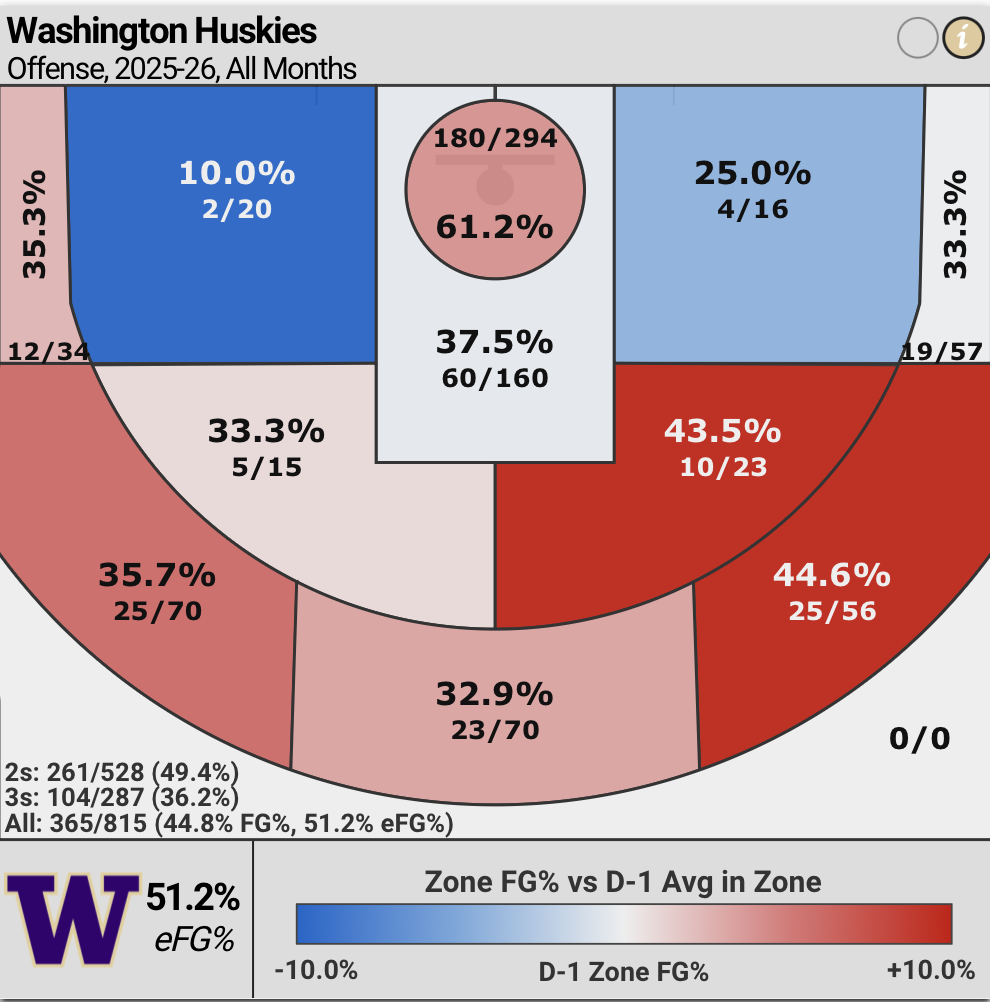
The Huskies average 74.5 points per game, and they do it with pace, spacing, and ruthless efficiency at the rim.
The Dawgs convert 61.2% of their shots within 4.5 feet (180-for-294), placing constant pressure on interior defenses.
When they’re not attacking the paint, they space the floor with 36.2% three-point shooting—right in line with last season’s 37% mark.
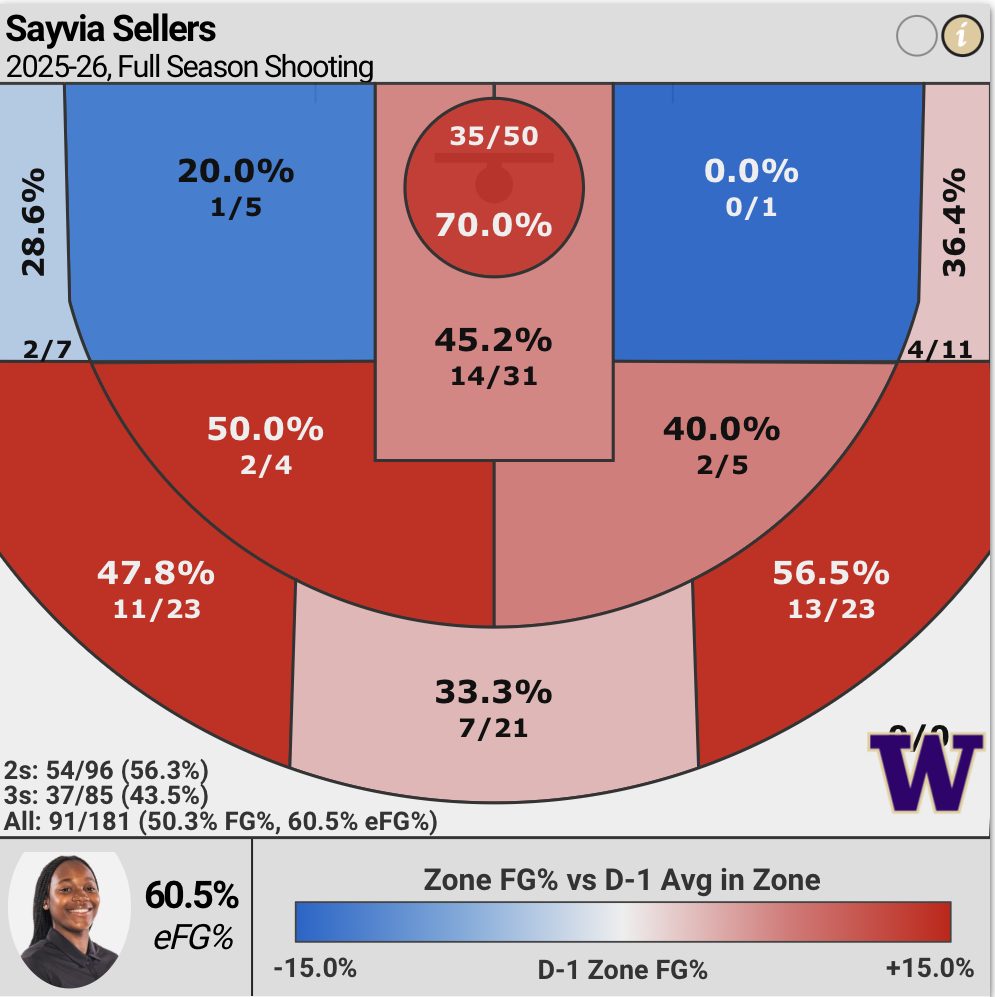
Junior 5’7″ point guard Sayvia Sellers, leads and ignites the Huskies offense with 19.2 points, 3.5 assists, and 1.6 steals per game, while chipping in an impressive 0.8 blocks per game.
Sellers is a red hot shooter from deep at 43.5% (37-for-85) and finishes 70% at the rim (35-for-50), forcing opposing defenses into impossible choices: chase her off the line and surrender the drive, or protect the paint and live with contested threes.
Against Michigan’s physical defense, Sellers’ shot selection and overall composed leadership will be critical.
Far from a one-woman show, Sellers is no longer shouldering the lion’s share of the offensive burden.
The Huskies now have a supporting offensive cast on the rise, giving UW Head Coach Tina Langley multiple ways to stress the Wolverines defense.
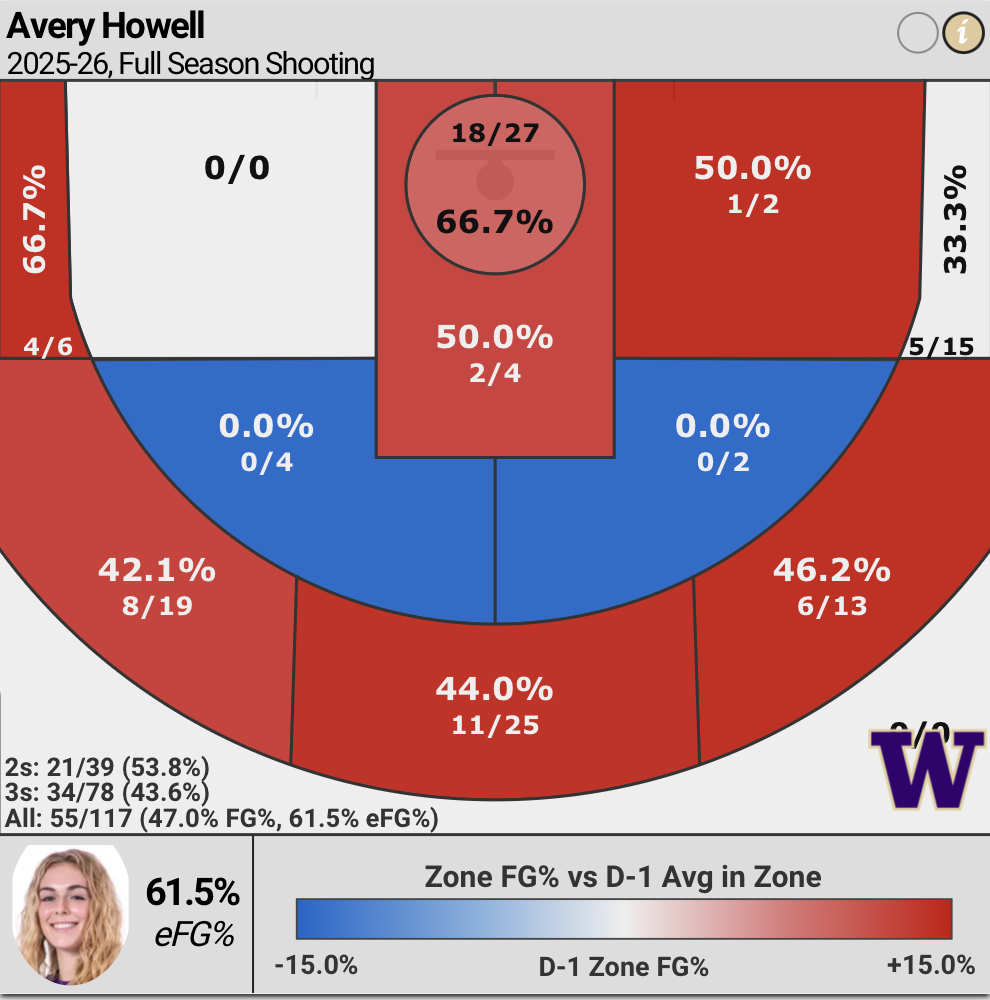
First, 6’0″ sophomore guard Avery Howell has emerged as a multi-faceted two-way star by averaging 13.2 points and 7.3 rebounds per game along with impressive defensive efficiency at 1.4 steals per game.
Howell leads the team in rebounding, but is also a lethal floor spacer with 43.6% accuracy from three (34-for-78).
Additionally, Howell scores 66.7% at the rim and 50% on limited lane attempts, making her a mismatch against slower or smaller defenders.
Then there is senior 5’11” guard Elle Ladine, rounding back into form at precisely the right time.
She averages 9.9 points and 4.6 rebounds, while shooting 32.1% from three.
However, Ladine’s true value lies in her ability to create her own shot and her toughness: Ladine is converting 66.7% at the rim plus 40% on lane “floaters” (albeit only 38.4% on mid-range attempts).
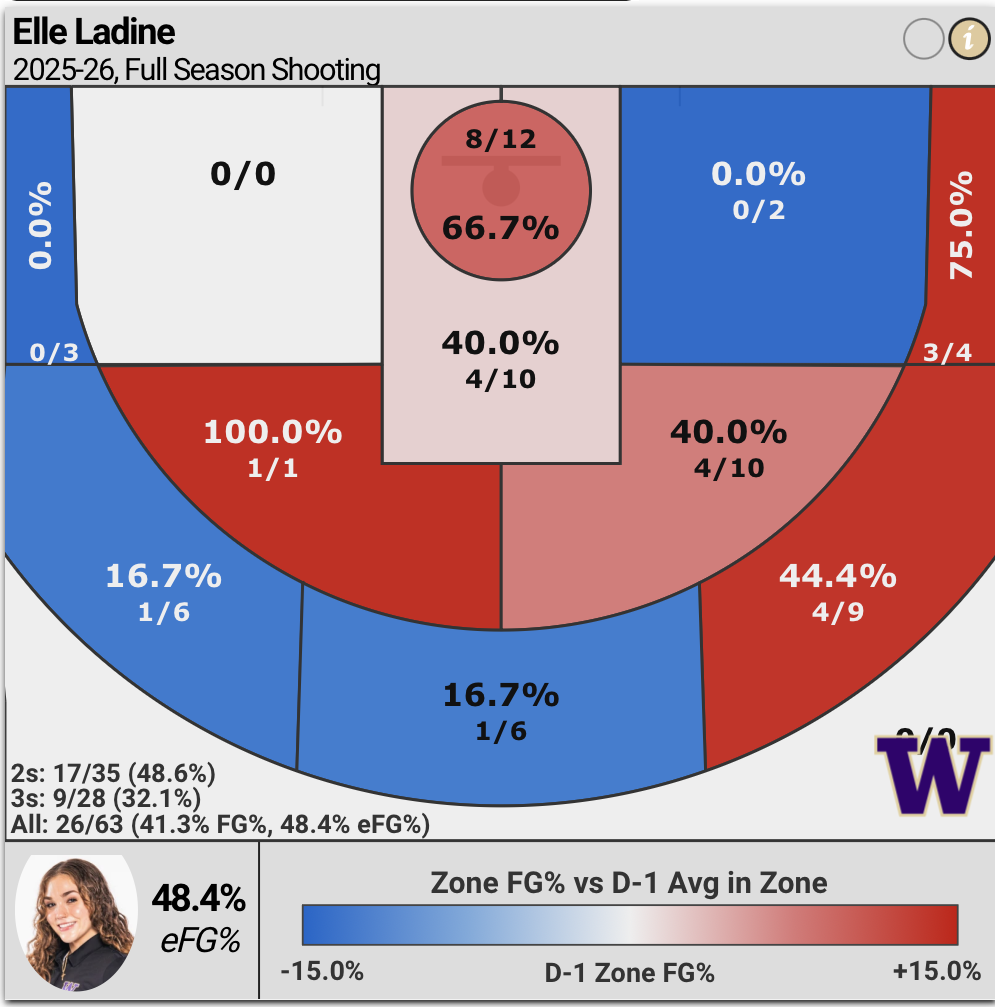
Elle Ladine’s recent 23-point breakout versus Northwestern, after coming off an early-season lower-body injury, suggests she’s ready to be a third primary threat.
If Ladine sustains that performance level, she could tilt this game in Washington’s favor.
Finally, freshman 6’3″ forward Brynn McGaughy provides length, rim protection, and opportunistic scoring.
McGaughy averages 8.2 points, 5.0 rebounds, and a team-leading 19 total blocks (1.5 per game).
Brynn McGaughy finishes 65.8% at the rim (25-for-38) and hits 60% from the free-throw-line extended area (6-for-10) — all hinting at a rapidly expanding offensive skillset.
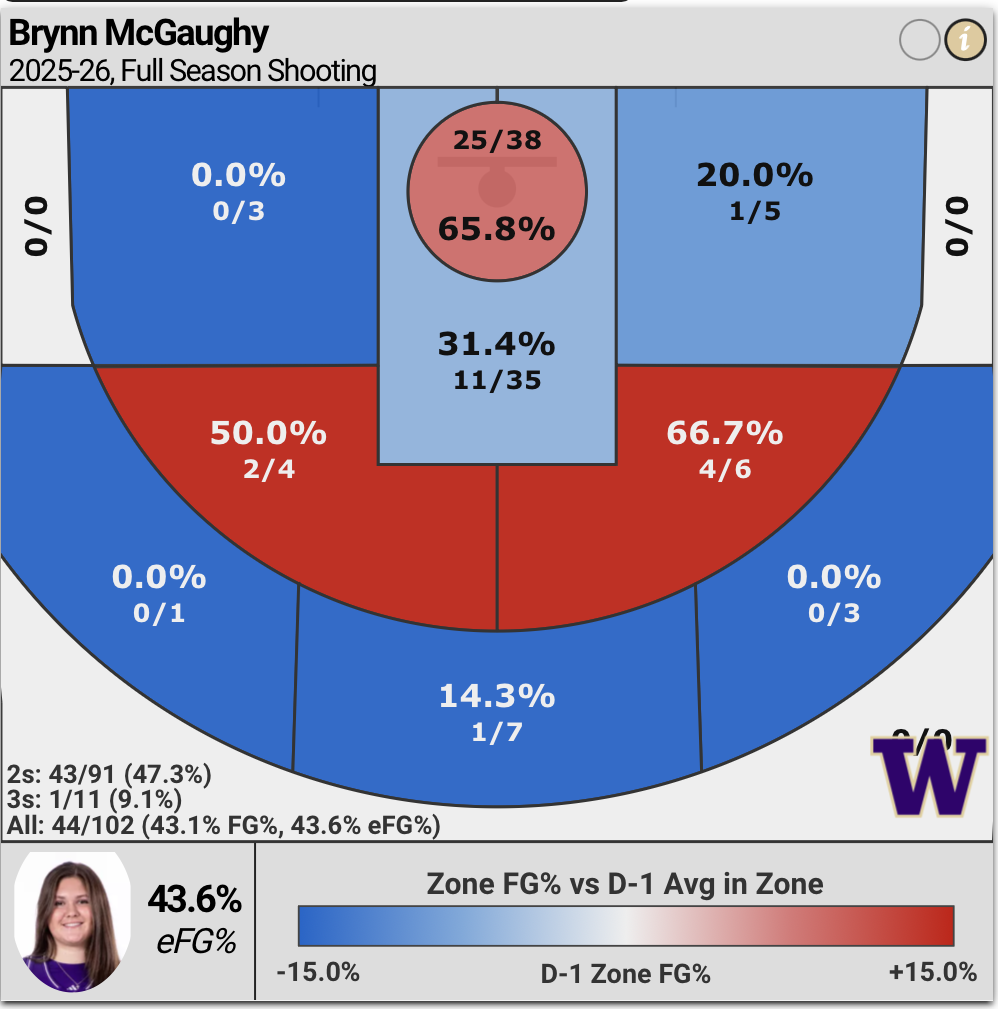
McGaughy’s presence gives Washington a versatile big capable of contesting shots inside, while consistently threatening defenses as a scorer.
Michigan Wolverines Preview
If Washington is about pace and spacing, Michigan is about length, power and precision — mixed with opportunity transition offense.
The Wolverines score an eye-popping 92.4 points per game while holding opponents to just 56.3, a jaw-dropping +36.1 average margin.
The Wolverines dominate inside, shooting 63.3% at the rim (250-for-395) and 56.1% on all two-point attempts.
Although Michigan shoots a respectable 34% from three (89-for-262), their real identity is built around paint touches and physical play.
Michigan’s rebounding numbers underline that identity:
27.3 defensive boards and 18.2 offensive rebounds per game.
In other words, even a strong defensive possession for Washington might not end with a single stop, if Michigan has its way on the offensive boards.
The Huskies’ guards and wings must rebound collectively to avoid giving extra possessions to a team that already scores efficiently on first attempts.
If Michigan controls the glass, Washington’s transition opportunities—and thus their offensive rhythm—could be limited.
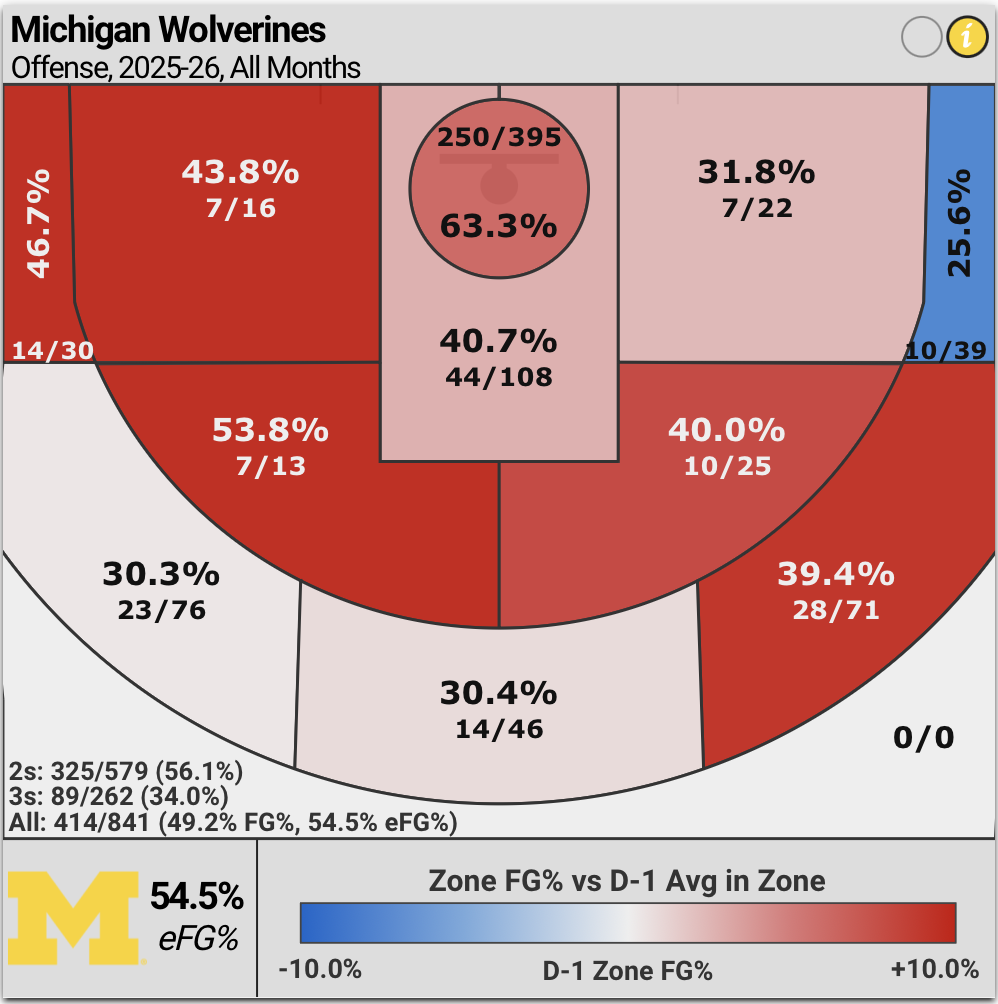
The Michigan Wolverines feature three players averaging double figures in scoring.
The Wolverines are led by 6’1″ sophomore guard Olivia Olson, who averages 18.3 points, 5.4 rebounds, 2.1 assists, and 2.0 steals.
Olson feasts in-the-paint, converting 67.3% at the rim and 48.5% from the lane.
While Olson is just 28.9% from three-point range overall, she is dangerous in specific spots (42.9% straightaway, 50% from the right wing).
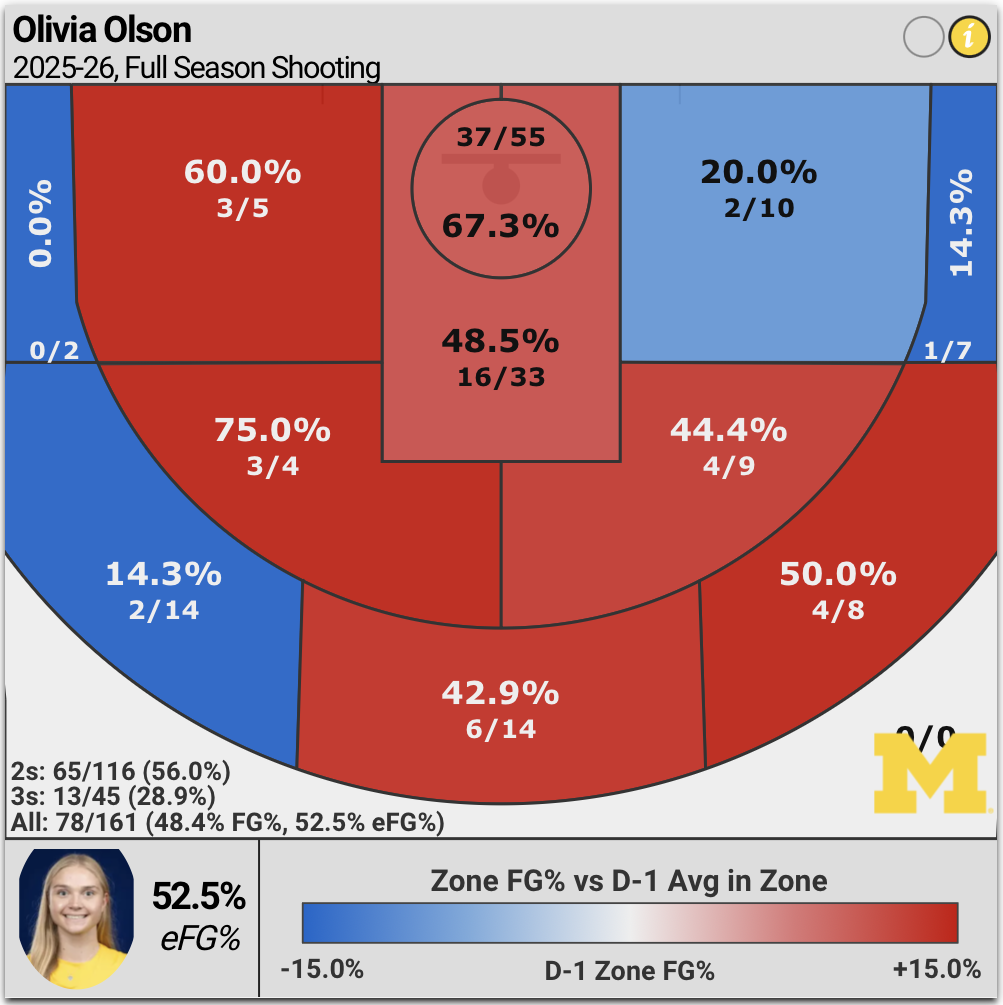
Washington defenders will need to cut off her dribble-drives without over-helping off the other Wolverines shooters.
Syla Swords, a multi-faceted 6’0″ sophomore guard, scores a second-leading 14.4 points per game; plus contributing a third-leading 5.3 rebounds; a third-leading 2.5 assists per game; and a fourth-leading 1.7 steals.
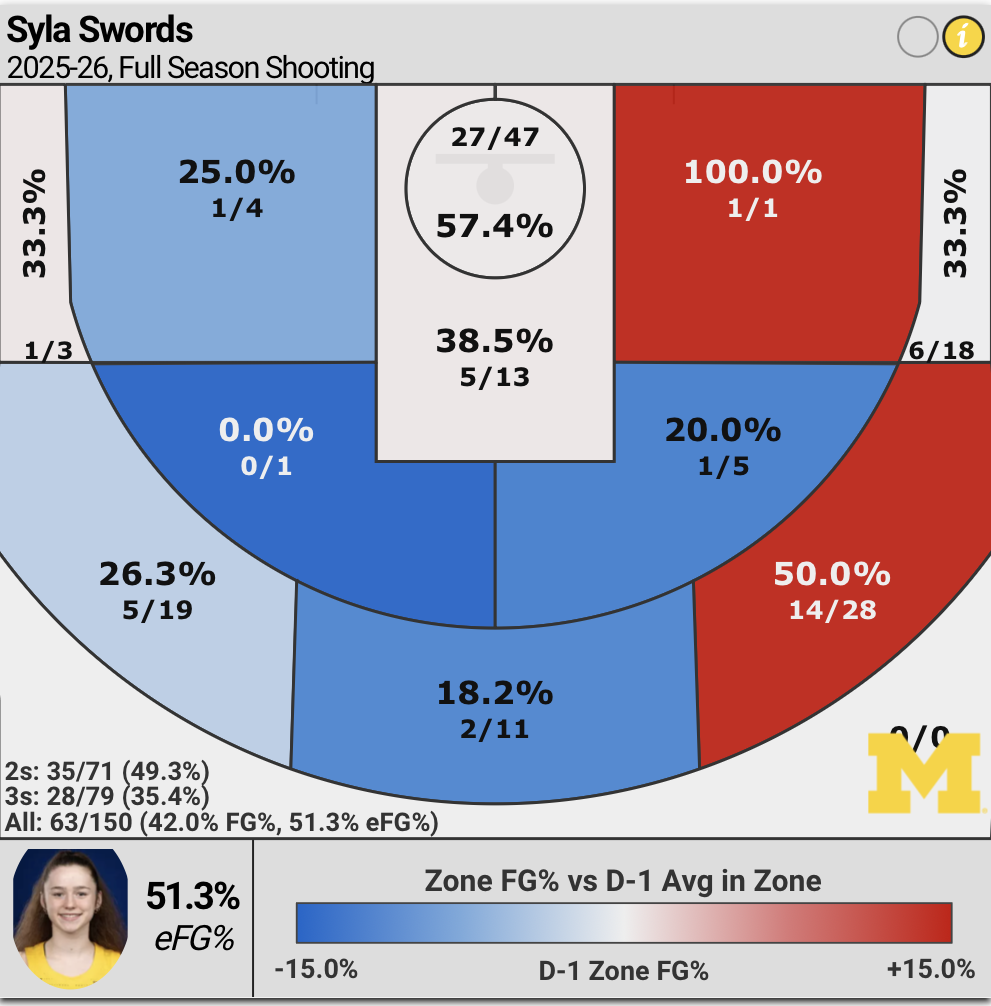
Swords provides inside-outside scoring versatility, with the majority of her shot attempts from three-point range (35.4% from deep); followed by inside-the-lane scoring attempts — making 57.4% of her shots at-the-rim (27 of 47) and 38.5% from farther out in the lane (5 of 13).
Mila Holloway, 5’10” sophomore guard, is Michigan’s third-leading scorer at 12.4 points per game; as well as a team-leading 5.2 assists; and a team-leading 2.3 steals per game.
Holloway is a true three-level scorer that is most effective scoring in the lane within 4.5 feet of the rim converting 68.4% (26 of 38); plus a competent 31.9% three-point shooter (15 of 47); and a highly efficient 61% mid-range scorer (11 of 18).
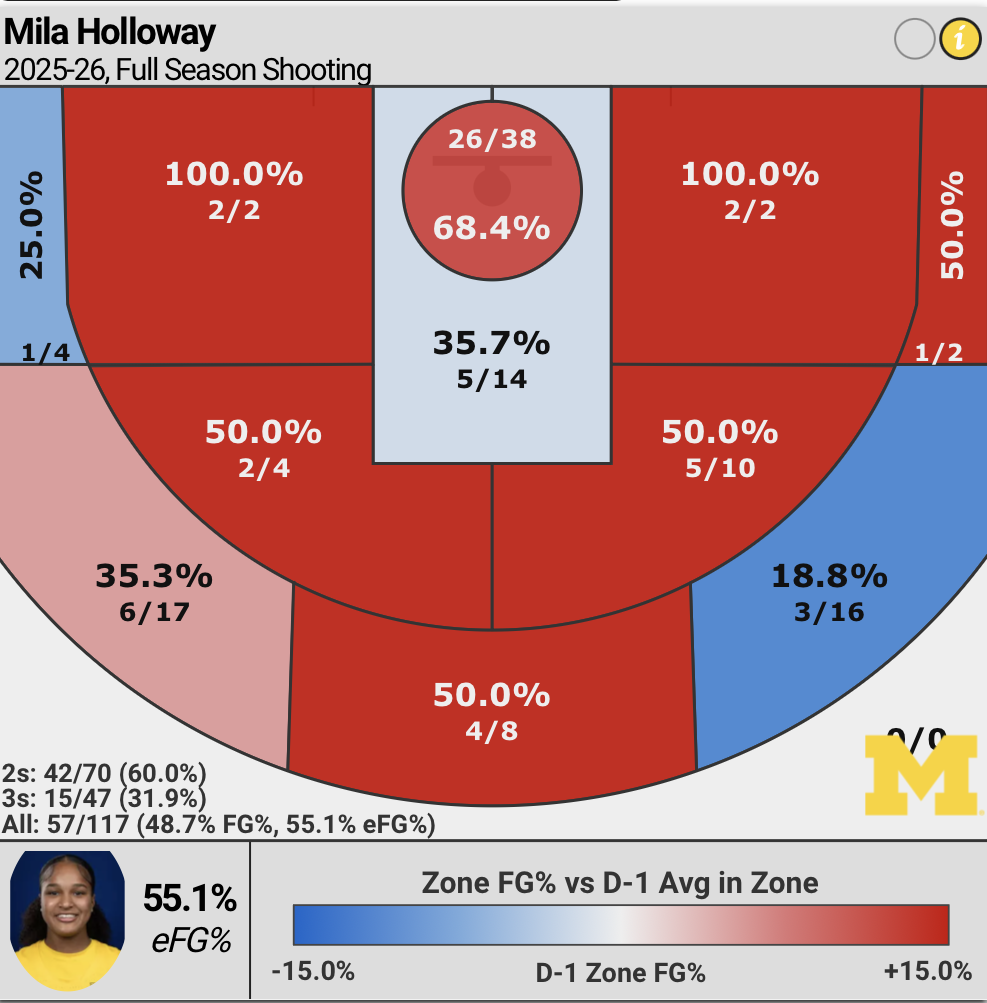
If Holloway and Sayvia Sellers matchup, expect an intense firefight of quick twitch scoring and decision-making versus disruptive defensive plays.
Another notable player is Michigan’s 6’3″ sophomore wing Te’Yala Delfosse is the fourth-leading scorer at 11.4 points per game; plus a team-leading 6.5 rebounds per game; and a second-leading 0.9 blocks.
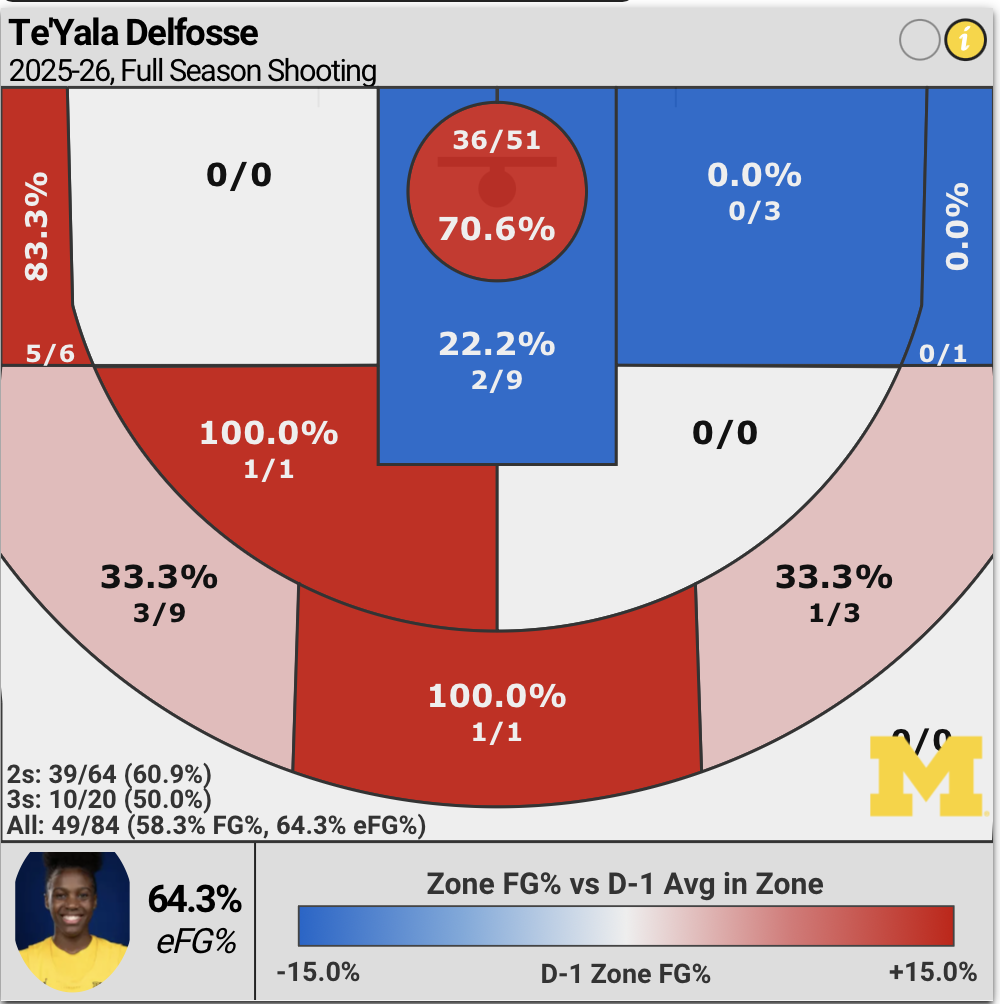
Surprisingly, Delfosse is a 50% three-point shooter on limited attempts (10 for 20).
Setting the stage for perhaps the most intriguing potential matchup in this contest: 6’3″ Te’Yala Delfosse versus Washington’s 6’3″ freshman Brynn McGaughy. If these two are matched up, this battle of versatility—McGaughy’s emerging skill and timing vs. Delfosse’s athleticism edge and experience — could swing stretches of the game on both ends.
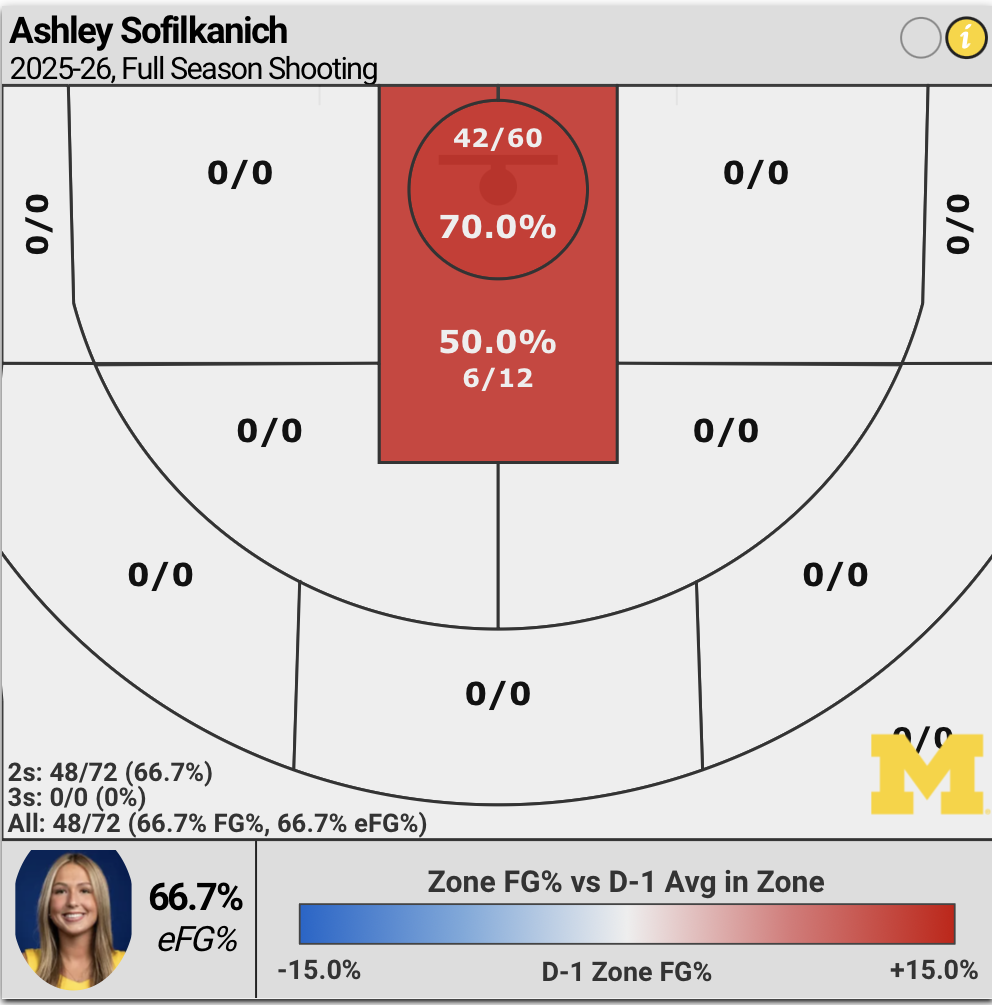
Finally, checking in at just under double figures in points is 6’3″ junior forward Ashley Sofilkanich at 9.8 points per game; 3.9 rebounds; and a team-leading 1.0 block per game.
Sofilkanich has one mission on offense: to dominate the lane with 70% efficiency at-the-rim (within 4.5 feet) and 50% shooting farther out in the lane.